Два роки – це лише мить у масштабах математичної нескінченності, але цілком достатній час, щоб започаткувати традицію, сформувати спільноту та побачити перші вагомі результати. Саме таку подію – два роки діяльності – в перший тиждень листопада відзначив математичний гурток Бердянського державного педагогічного університету, який за цей час пройшов шлях від ініціативи для зацікавлених математикою здобувачів освіти до спільноти, що об’єднує математичні ідеї, STEM-підходи, науковий пошук і людей із різних освітніх напрямів.
До свого другого дня народження гурток підійшов із назвою «Інтеграл БДПУ» та слоганом «Об’єднуємо знання – створюємо майбутнє!». І це не просто оновлення назви: інтеграл символізує об’єднання окремих складників у єдине ціле, а саме таку ідею ми прагнемо втілювати в діяльність гуртка: поєднувати математику та STEM, теоретичні знання з практичними застосуваннями, фундаментальні наукові ідеї і сучасні технології, індивідуальні зацікавлення з колективною творчістю.
За два роки до гуртка записалися 99 осіб! А якщо врахувати керівника, то Google-група «Інтеграл БДПУ» налічує рівно 100 учасників. Це не просто красива ювілейна цифра: група стала своєрідним цифровим архівом нашої діяльності. Тут зібрано матеріали зустрічей гуртка від 2024 року й до сьогодні, тож кожен учасник може асинхронно ознайомитися з темами, ідеями та напрацюваннями попередніх засідань, повернутися до цікавого матеріалу або відкрити для себе те, що свого часу пропустив.
Важливим результатом двох років роботи стали наукові здобутки гуртківців. Із 37 тез доповідей міжнародних і всеукраїнських наукових конференцій, підготовлених здобувачами освіти за цей час під керівництвом доцента кафедри фізики, математики та методики навчання БДПУ Миколи Кудінова, 27 (майже 73%) належать учасникам гуртка. За кожною з цих публікацій – самостійний пошук ідей, опрацювання джерел, математичні міркування, підтримка та наукове наставництво керівника гуртка, спроби сформулювати власну ідею й представити її науковій спільноті.
Особливо тішить, що «Інтеграл БДПУ» не обмежується одним факультетом і відкритий для всіх, кому цікаві математика, STEM та інтелектуальна діяльність. З березня 2026 року активною учасницею гуртка є здобувачка освіти факультету психолого-педагогічної освіти та мистецтв, а протягом ювілейного тижня до спільноти долучилися одразу троє представників студентського самоврядування цього факультету: голова та секретар Студентської ради, а також керівник одного з її секторів.
Це особливо символічно, адже математика потрібна не лише тим, хто в майбутньому викладатиме її в закладах загальної середньої освіти: вона формує логічне мислення, уміння помічати закономірності, аналізувати інформацію та знаходити нестандартні рішення. Сподіваємося, що така співпраця сприятиме посиленню математичної і STEM-складової підготовки майбутніх фахівців дошкільної та початкової освіти. Адже саме їм належить важлива місія – допомагати новій генерації дітей відкривати світ знань, не боятися складних запитань і з раннього віку розвивати допитливість та інтерес до дослідження.
Ми розуміємо, що не всі охочі можуть долучатися до онлайн-зустрічей у визначений час. Тому, окрім Google-групи, маємо власну групу в месенджері, де керівник надсилає матеріали, що особливо корисні тим, хто не зміг бути присутнім на засіданні. А ще щотижня проводимо голосування щодо можливого часу наступної зустрічі. Гуртківці обирають зручні часові слоти, а результати допомагають визначити той, у який зможе долучитися якомога більше учасників. Такий підхід дає змогу гнучко планувати роботу, враховувати навчальний розклад та підтримувати регулярність зустрічей.
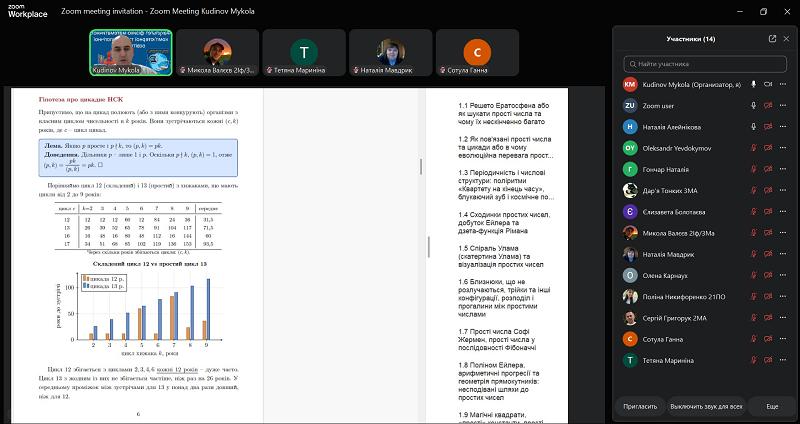
Ювілейне засідання ми присвятили простим числам навколо нас, спробувавши поглянути на них як на явище, що несподівано поєднує математику з природою, музикою, механікою та навіть пошуком позаземного розуму.
Чому деякі види періодичних цикад з’являються над землею з інтервалами у 13 або 17 років? Ці числа прості, а їхні особливі арифметичні властивості можуть давати еволюційну перевагу, зокрема зменшуючи ймовірність збігу циклів із життєвими циклами хижаків. Так математика допомагає побачити приховану логіку природних ритмів.
Прослухавши фрагмент «Квартету на кінець часу» французького композитора Олів’є Мессіана, написаного у 1940 році в таборі для військовополонених і вперше виконаного там у січні 1941 року, звернули особливу увагу на першу частину твору – «Liturgie de cristal». У ній ритмічний цикл із 17 тривалостей накладається на гармонічний цикл із 29 акордів. Обидва числа прості, а повне повторне узгодження циклів відбулося б лише через 17 · 29 = 493 кроки. Така взаємодія циклів створює враження руху, який ніби повторюється, але щоразу постає в іншому поєднанні. Математика тут стає не просто інструментом аналізу музики, а частиною її художньої архітектури.
Ще один несподіваний приклад ми знайшли в машинобудуванні. Уявімо дві зчеплені шестерні з M та N зубцями. Кожен зуб першої шестерні за повний цикл роботи контактуватиме з N/НСД(M, N) різними зубцями другої. Якщо кількість зубців взаємно проста, тобто НСД(M, N) = 1, кожен зуб першої шестерні зустрінеться з усіма зубцями другої. Такий принцип називають «блукаючим зубом» (hunting tooth): він сприяє рівномірнішому розподілу зношування деталей. І знову властивість простих чисел виявляється корисною далеко за межами суто математичних задач!
Ми також згадали про радіопослання, надіслане 16 листопада 1974 року з радіотелескопа в Аресібо у бік кульового зоряного скупчення M13. Воно містило 1679 бітів інформації. Але чому саме таку кількість? Тому що 1679 = 23 · 73 – добуток двох простих чисел. Завдяки цьому бітову послідовність можна подати у вигляді прямокутника розміром 23 × 73, що дає змогу відновити двовимірну структуру закодованого повідомлення. Ця ідея перегукується з романом Карла Сагана «Контакт» (1985) та його екранізацією 1997 року, у яких учені розпізнають штучне походження космічного сигналу за послідовністю імпульсів, що відповідає простим числам: 2, 3, 5, 7, …, 101. Адже природні процеси не мають очевидної причини відтворювати саме таку послідовність, тоді як для розумної цивілізації вона може стати своєрідним математичним «рукостисканням».
Ці приклади – лише невелика частина того, що відкриває світ простих чисел. Вони нагадують, що математика не замкнена в підручниках і формулах: вона звучить у музиці, прихована в природних циклах, працює в механізмах, допомагає передавати інформацію та навіть стає мовою уявного міжзоряного діалогу. Саме такі несподівані перетини роблять наші зустрічі особливими.
Два роки – це вже історія, яку ми створили разом, але водночас лише початок. «Інтеграл БДПУ» продовжує розвиватися, відкривати нові напрями, залучати учасників з усіх куточків України та світу, перетворюючи цікавість до математики на спільні дослідження та творчі проєкти. Ми раді кожному, хто хоче не просто отримувати готові відповіді, а ставити запитання, шукати закономірності, експериментувати та ділитися власними відкриттями.
Тож, об’єднуймо знання та створюймо майбутнє! Якщо вам близькі математика, STEM, наукові загадки та інтелектуальні пригоди – запрошуємо до нашої спільноти!
За матеріалами доцента кафедри ФММН Миколи Кудінова
“BSPU Integral”: Bringing Knowledge Together – Creating the Future!
Two years may be just a fleeting moment on the scale of mathematical infinity, yet they are more than enough time to establish a tradition, build a community, and achieve the first significant results. In the first week of November, the Mathematics Club of Berdyansk State Pedagogical University (BSPU) celebrated its second anniversary. Over this period, it has evolved from an initiative for students interested in mathematics into a community that brings together mathematical ideas, STEM approaches, research, and people from diverse academic backgrounds.
The club marked its second anniversary with a new name, “BSPU Integral,” and the slogan “Bringing Knowledge Together – Creating the Future!” This is more than just a change of name. The integral symbolizes the bringing together of individual elements into a unified whole, and this is precisely the idea we seek to put into practice through the club’s activities: combining mathematics and STEM, theoretical knowledge and practical applications, fundamental scientific ideas and modern technologies, as well as individual interests and collective creativity.
Over the past two years, 99 people have registered with the club! Including its leader, the “BSPU Integral” Google Group now has exactly 100 members. This is more than just an impressive anniversary figure: the group has become a kind of digital archive of our activities. It contains materials from club meetings dating back to 2024, allowing every member to explore the topics, ideas, and outcomes of previous sessions asynchronously, revisit interesting materials, or discover something they may have missed at the time.
One of the most important achievements of these two years has been the club members’ research output. Of the 37 conference abstracts prepared by students for international and all-Ukrainian academic conferences under the supervision of Mykola Kudinov, Associate Professor at the BSPU Department of Physics, Mathematics and Teaching Methods, 27 (73%) were authored by club members. Behind each of these publications lies an independent search for ideas, a study of relevant sources, mathematical reasoning, the support and academic mentorship of the club leader, and attempts to formulate original ideas and present them to the academic community.
It is particularly encouraging that “BSPU Integral” is not limited to a single faculty and is open to everyone interested in mathematics, STEM, and intellectual pursuits. Since March 2026, an active club member has been a student from the Faculty of Psychological and Pedagogical Education and Arts. During the anniversary week, three more representatives of this faculty’s student self-government joined the community: the Chair and Secretary of the Student Council, as well as the Head of one of its sectors.
This is particularly symbolic because mathematics is essential not only for those who will teach it in general secondary education institutions in the future. It develops logical thinking, the ability to recognize patterns, analyze information, and find unconventional solutions. We hope that this collaboration will strengthen the mathematical and STEM components of the training of future preschool and primary school educators. After all, they have an important mission: to help a new generation of children discover the world of knowledge, feel confident when facing challenging questions, and develop curiosity and an interest in exploration from an early age.
We understand that not everyone interested in the club can attend online meetings at scheduled times. Therefore, alongside our Google Group, we also have a dedicated messaging group where the club leader shares materials, which are especially useful for those who could not attend a session. We also hold a weekly poll to determine a convenient time for the next meeting. Club members choose the time slots that suit them, and the results help us select the time when the largest possible number of participants can join. This approach allows us to plan activities flexibly, take academic schedules into account, and maintain regular meetings.
Our anniversary session was devoted to prime numbers in the world around us. We explored them as a phenomenon that unexpectedly connects mathematics with nature, music, mechanics, and even the search for extraterrestrial intelligence.
Why do some species of periodical cicadas emerge above ground at intervals of 13 or 17 years? These are prime numbers, and their distinctive arithmetic properties may offer an evolutionary advantage, in particular by reducing the likelihood of their life cycles coinciding with those of predators. Mathematics thus helps us uncover the hidden logic behind natural rhythms.
After listening to an excerpt from Quartet for the End of Time by French composer Olivier Messiaen, written in 1940 in a prisoner-of-war camp and first performed there in January 1941, we paid particular attention to the first movement, Liturgie de cristal. In this movement, a rhythmic cycle of 17 durations is superimposed on a harmonic cycle of 29 chords. Both numbers are prime, and the two cycles would fully realign only after 17 × 29 = 493 steps. This interaction creates an impression of motion that seems to repeat itself, yet each time unfolds in a different combination. Here, mathematics is not merely a tool for analyzing music but becomes part of its artistic architecture.
We found another unexpected example in mechanical engineering. Imagine two meshing gears with M and N teeth, respectively. Over a complete cycle, each tooth of the first gear will come into contact with N/gcd(M, N) different teeth of the second gear. If the numbers of teeth are relatively prime, that is, gcd(M, N) = 1, every tooth of the first gear will meet every tooth of the second. This principle is known as the “hunting tooth” principle: it helps distribute wear more evenly across the gear teeth. Once again, a property of prime numbers proves useful far beyond purely mathematical problems!
We also discussed the Arecibo message, transmitted on November 16, 1974, from the Arecibo radio telescope toward the globular star cluster M13. It contained 1,679 bits of information. But why exactly this number? Because 1,679 = 23 × 73, the product of two prime numbers. This makes it possible to arrange the bit sequence into a 23 × 73 rectangle, revealing the two-dimensional structure of the encoded message. This idea echoes Carl Sagan’s novel Contact (1985) and its 1997 film adaptation, in which scientists recognize the artificial origin of a cosmic signal through a sequence of pulses corresponding to prime numbers: 2, 3, 5, 7, …, 101. After all, natural processes have no obvious reason to reproduce precisely such a sequence, whereas for an intelligent civilization it could serve as a kind of mathematical “handshake.”
These examples are only a small part of what the world of prime numbers has to offer. They remind us that mathematics is not confined to textbooks and formulas: it resonates in music, lies hidden in natural cycles, operates in mechanical systems, helps transmit information, and can even become the language of an imaginary interstellar dialogue. It is precisely these unexpected connections that make our meetings special.
Two years have already become a story we have created together, but they are also just the beginning. “BSPU Integral” continues to grow, explore new areas, welcome participants from across Ukraine and around the world, and turn curiosity about mathematics into collaborative research and creative projects. We are delighted to welcome everyone who wants not simply to receive ready-made answers but to ask questions, seek patterns, experiment, and share their own discoveries.
So let us bring knowledge together and create the future! If you are passionate about mathematics, STEM, scientific mysteries, and intellectual adventures, we invite you to join our community!
