
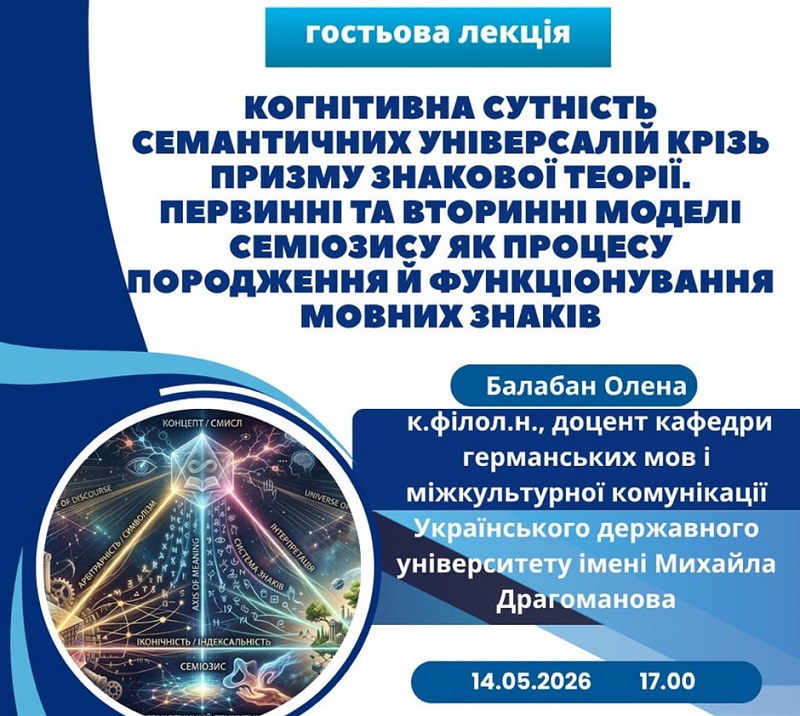
14 травня 2026 року о 17:00 у БДПУ відбулася гостьова лекція «Когнітивна сутність семантичних універсалій крізь призму знакової теорії». Кафедрою української мови та журналістики було запрошено спікерку – кандидатку філологічних наук, доцентку кафедри германських мов і міжкультурної комунікації УДУ ім. Михайла Драгоманова Олену Балабан. Мета лекції – ознайомити учасників з ключовими аспектами мовознавства.
Тема лекції є надзвичайно актуальною у контексті сучасного мовознавства, яке дедалі більше звертається до міждисциплінарних підходів. Когнітивна лінгвістика, семіотика та теорія семантичних універсалій перебувають на перетині мовознавства, філософії та когнітивних наук, що робить їх вивчення особливо цінним для філологів, які прагнуть не лише описувати мовні явища, а й розуміти глибинні механізми їх виникнення та функціонування. У добу глобалізації та активних міжкультурних контактів знання про універсальні закономірності мови стає інструментом для розуміння як власної, так і чужої культури.
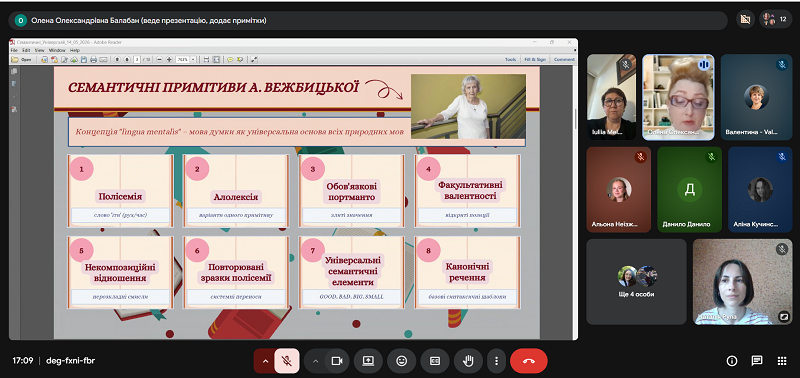
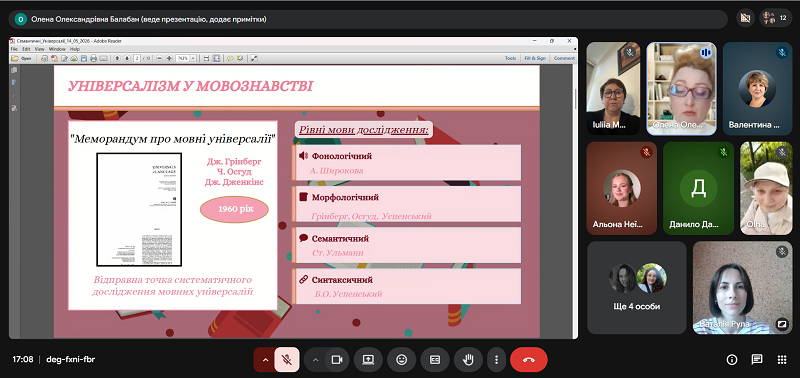
На початку лекції детально обговорили рівні мовознавчого дослідження, серед яких: фонологічний, морфологічний, семантичний та синтаксичний. Далі спікерка розповіла про семантичні примітиви польської лінгвістки Анни Вежбицької, які допомагають зрозуміти структуру мови. Наступними були розглянуті типи лексико-семантичних універсалій від лінгвістів Сагіта Шафікова (універсалії семантичного поля, універсалії зв’язку одиниць поля та універсалії внутрішньої форми) та Стефана Ульмана (описова семантика, історична семантика та структура лексики).
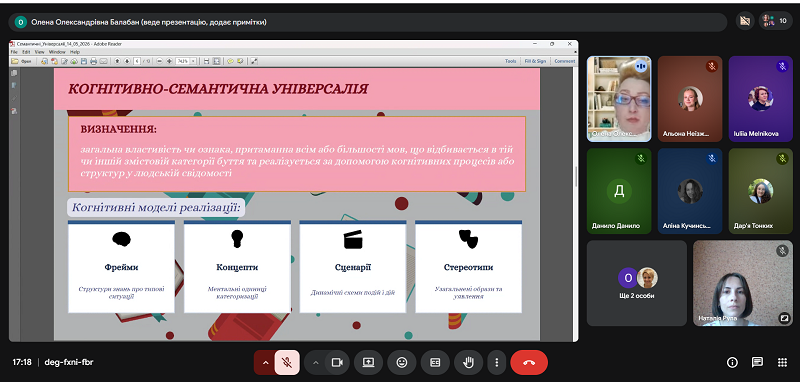
Окрему увагу приділили когнітивні моделям реалізації (фрейми, концепти, сценарії та стереотипи), визначення семіотики, знакову систему Чарльза Пірса, серед яких ікони, індекси та символи.
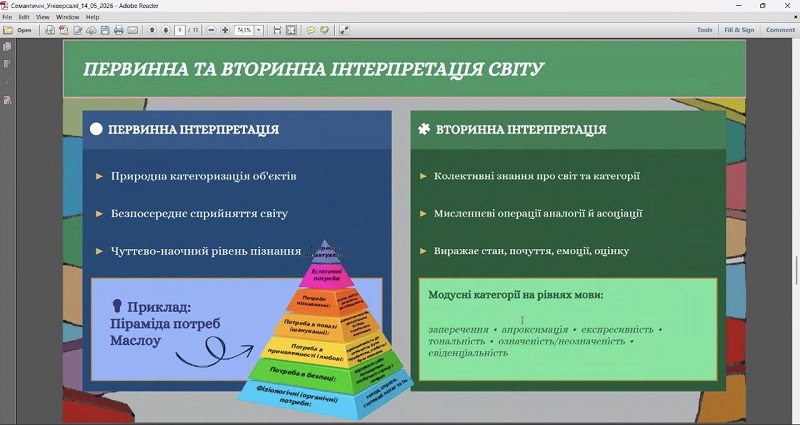
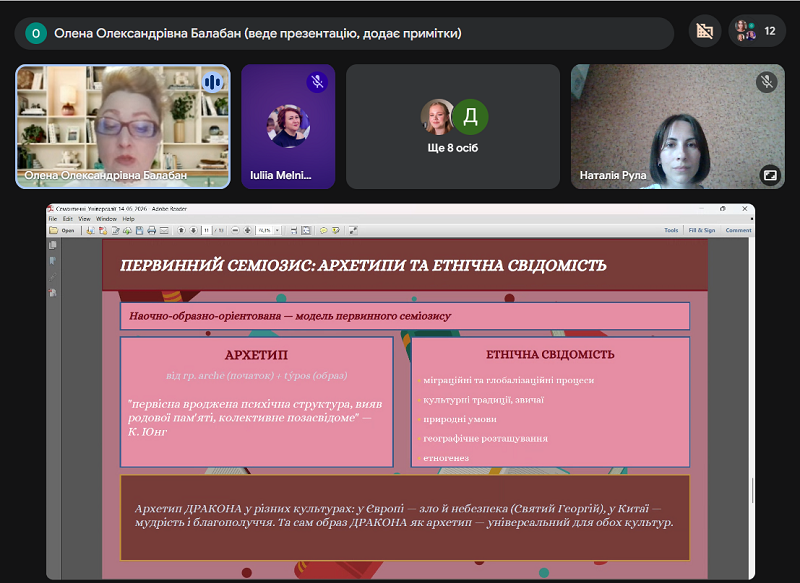
На завершення були висвітлені первинна та вторинна інтерпретації світу, складові колективного знання, первинний семіозис (архетипи та етнічна свідомість), гносеологічна-орієнтована та ментально-орієнтована моделі вторинного семіозису.
Для філологів знакова теорія та концепція семантичних примітивів відкривають нові дослідницькі горизонти. Розуміння того, як мова конструює картину світу через фрейми, концепти та стереотипи, дає дослідникам можливість аналізувати тексти на значно глибшому рівні – не лише формально, а й змістовно, враховуючи культурний, історичний та когнітивний контекст. Це особливо важливо в перекладознавстві, лексикографії, лінгвокультурології та інших прикладних галузях філологічної науки, де точне розуміння значення та його меж є фундаментальним завданням.
Нарешті, осмислення первинного та вторинного семіозису, архетипів та етнічної свідомості є вкрай важливим для філологів, які займаються дослідженням української мови та культури. В умовах сьогодення, коли питання мовної і культурної ідентичності набувають особливої ваги, розуміння механізмів формування колективного знання та мовної картини світу стає не лише академічним завданням, а й справою суспільної відповідальності. Саме тому такі лекції, як проведена 14 травня 2026 року у БДПУ, є важливою частиною фахової підготовки сучасного філолога.
За матеріалами кафедри української мови та журналістики
Language Through the Lens of the Sign: A Guest Lecture at BSPU
On May 14, 2026, at 5:00 PM, Berdyansk State Pedagogical University hosted a guest lecture titled “The Cognitive Essence of Semantic Universals Through the Lens of Sign Theory.” The Department of Ukrainian Language and Journalism invited the speaker – Olena Balaban, Candidate of Philological Sciences, Associate Professor of the Department of Germanic Languages and Intercultural Communication at Mykhailo Drahomanov Ukrainian State University. The aim of the lecture was to introduce participants to key aspects of linguistics.
The topic of the lecture is extremely relevant in the context of contemporary linguistics, which is increasingly turning to interdisciplinary approaches. Cognitive linguistics, semiotics, and the theory of semantic universals stand at the intersection of linguistics, philosophy, and cognitive sciences, making their study particularly valuable for philologists who seek not only to describe linguistic phenomena but also to understand the underlying mechanisms of their emergence and functioning. In an era of globalization and active intercultural contacts, knowledge of universal linguistic patterns becomes a tool for understanding both one’s own and other cultures.
At the beginning of the lecture, the levels of linguistic research were discussed in detail, including phonological, morphological, semantic, and syntactic levels. The speaker then spoke about the semantic primitives of Polish linguist Anna Wierzbicka, which help to understand the structure of language. Next, the types of lexico-semantic universals were examined – those proposed by linguists Sagit Shafikow (universals of the semantic field, universals of field unit relations, and universals of inner form) and Stephen Ullmann (descriptive semantics, historical semantics, and the structure of the lexicon).
Special attention was given to cognitive models of realization (frames, concepts, scenarios, and stereotypes), the definition of semiotics, and Charles Peirce’s sign system, which includes icons, indices, and symbols.
In conclusion, the primary and secondary interpretations of the world were highlighted, along with the components of collective knowledge, primary semiosis (archetypes and ethnic consciousness), and the epistemologically oriented and mentally oriented models of secondary semiosis.
For philologists, sign theory and the concept of semantic primitives open up new research horizons. Understanding how language constructs a picture of the world through frames, concepts, and stereotypes allows researchers to analyze texts at a much deeper level – not only formally, but also substantively, taking into account cultural, historical, and cognitive contexts. This is especially important in translation studies, lexicography, linguistic culturology, and other applied fields of philological science, where a precise understanding of meaning and its boundaries is a fundamental task.
Finally, reflecting on primary and secondary semiosis, archetypes, and ethnic consciousness is of utmost importance for philologists engaged in the study of the Ukrainian language and culture. In today’s world, where questions of linguistic and cultural identity are gaining particular significance, understanding the mechanisms of collective knowledge formation and the linguistic worldview becomes not merely an academic task, but also a matter of social responsibility. This is precisely why lectures such as the one held on May 14, 2026 at BSPU are an important part of the professional training of the modern philologist.
Based on materials from the Department of Ukrainian Language and Journalism
