
Що сьогодні стає на заваді для українських студентів у Європі?
На це питання шукали відповідь:
- проректорка з наукової роботи Яна Сичікова;
- професор кафедри германської філології та методики викладання германських мов Мелітопольського державного педагогічного університету імені Богдана Хмельницького Ірина Глазкова;
- викладач кафедри іноземних мов та методики викладання БДПУ Володимир Татарін.
Стаття “Бар’єри для реалізації права на освіту: переміщені українські студенти університетів під тимчасовим захистом у ЄС” була опублікована у червні 2026 року у журналі “Огляд освіти з прав людини”.
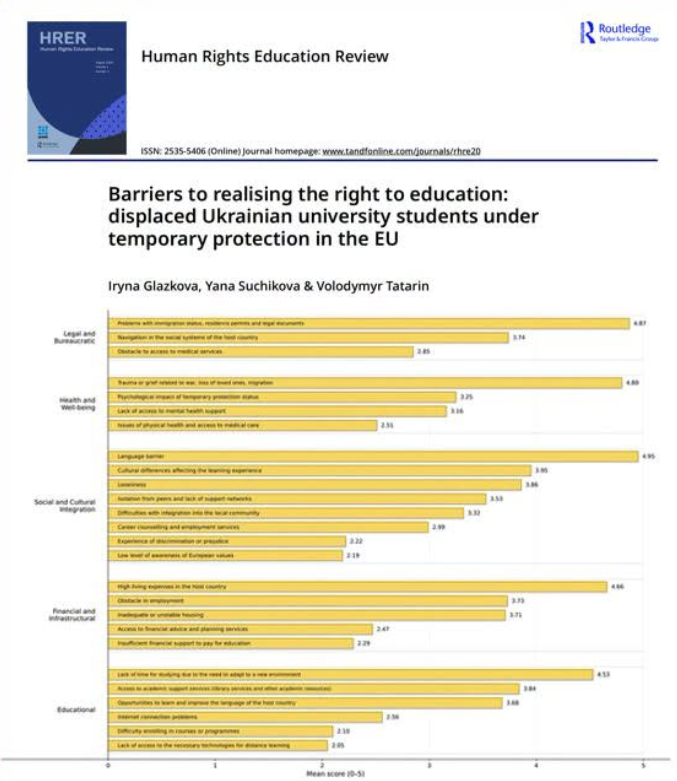
Дослідники провели опитування 224 студентів з ТОТ, що продовжили навчання в БДПУ і наразі знаходяться у різних країнах Європейського Союзу.
Результати показові: лише технічний доступ до дистанційного онлайн-навчання не гарантує доступності освіти. За результатами опитування, перешкодами є:
- іншомовне середовище;
- проблеми із правовим статусом;
- психологічні наслідки війни;
- вартість життя у країні перебування;
- нестача часу через потребу в адаптації до нового середовища.
Як коментує пані Яна на своїй фейсбук-сторінці: “перешкодою для навчання часто стає не складний курс чи іспит, а необхідність одночасно шукати житло, оформлювати документи, працювати та допомагати родині”.
Ці та інші результати дослідження можна переглянути за посиланням: https://doi.org/10.1080/25355406.2026.2690211 .
“Огляд освіти з прав людини” (“Human Rights Education Review”, HRER) – міждисциплінарний журнал, що отримав премію 2021 року від Консорціуму університетів і коледжів з освіти з прав людини «за значний внесок у міжнародні дослідження та майбутнє викладання, навчання та співпрацю в освіті з прав людини по всьому світу». Висвітює “публічну дискусію про права людини та демократичне навчання через міжнародний обмін ідеями та практикою”.
За матеріалами фейсбук-сторінки Яни Сичікової
Barriers to Education: Research
What is getting in the way of Ukrainian students in Europe today?
The following people sought an answer to this question:
- Vice-Rector for Scientific Work Yana Sychikova;
- Professor of the Department of Germanic Philology and Methods of Teaching Germanic Languages at the Bohdan Khmelnytsky Melitopol State Pedagogical University Iryna Glazkova;
- Lecturer of the Department of Foreign Languages and Methods of Teaching at the BSPU Volodymyr Tatarin.
The article “Barriers to the Implementation of the Right to Education: Displaced Ukrainian University Students Under Temporary Protection in the EU” was published in June 2026 in the journal “Review of Education for Human Rights”.
The researchers conducted a survey of 224 students from TOT who continued their studies at the BSPU and are currently in different countries of the European Union.
The results are indicative: only technical access to online distance learning does not guarantee the accessibility of education. According to the survey results, the obstacles are:
- foreign-language environment;
- problems with legal status;
- psychological consequences of war;
- cost of living in the host country;
- lack of time due to the need to adapt to a new environment.
As Yana Sychikova comments on her Facebook page: “the obstacle to studying is often not a difficult course or exam, but the need to simultaneously look for housing, apply for documents, work and help the family”.
These and other research results can be viewed at the link: https://doi.org/10.1080/25355406.2026.2690211 .
Human Rights Education Review (HRER) is an interdisciplinary journal that received the 2021 Human Rights Education Consortium Award “for its significant contribution to international research and the future of teaching, learning, and collaboration in human rights education worldwide”. It promotes “public debate on human rights and democratic learning through international exchange of ideas and practices”.
Based on materials from Yana Sychikova’s Facebook page
