
15 червня 2026 року проректорка з наукової роботи Бердянського державного педагогічного університету Яна Сичікова провела лекцію, присвячену сучасній науковій комунікації.
Аудиторія – Інститут вищої освіти Національної академії педагогічних наук України.
Темою стали зміни в науці сьогодення: «Для кого ми пишемо наукові статті? Переосмислення наукової комунікації».
Лекторка ставить питання:
- коли насправді стаття стає видимою;
- як дискусія стає поштовхом до спіпраці;
- яка функція наукового журналу;
- де є межі обговорення в науці…
І її відповідь така: шлях публікації починається на конференціях, семінарах, у препринтах і відкритих репозитаріях.
Співпраця починається з обміну досвідом: «Серія наших публікацій про концепцію “Університету без стін” стала поштовхом до співпраці з австралійськими медіа та університетами, проведення симпозіумів, відкритих лекцій, подкастів та участі в публічних дискусіях про майбутнє вищої освіти в умовах криз».
Наукові журнали змінюють традиційні ролі: вони «не лише публікують результати, а й створюють простір для наукової дискусії та самокорекції науки».
Тож чи є тут межі? Екосистема комунікації не обмежується сторінками журналів – це люди, цифрові платформи, машинні агенти; це простір співпраці.
«… ми пишемо наукові статті не для рецензентів чи редакторів. Ми пишемо їх для колег, студентів, журналістів, управлінців, громад і всіх тих, хто сьогодні або завтра прийматиме рішення на основі знань», – підсумовує пані Яна головну думку лекції.
Презентація виступу доступна за посиланням: https://doi.org/10.5281/zenodo.20698147
За матеріалами фейсбук-сторінки Яни Сичікової
Guest Lecture: Rethinking Scientific Communication
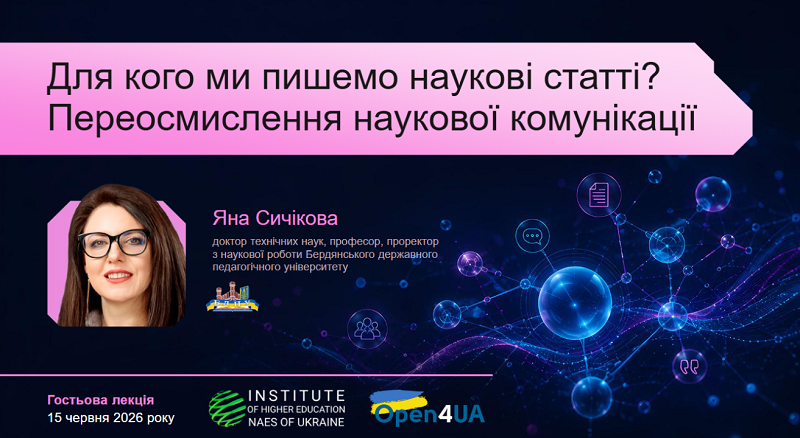
On June 15, 2026, Yana Sychikova, Vice-Rector for Scientific Work of Berdyansk State Pedagogical University, gave a lecture dedicated to modern scientific communication.
Audience – Institute of Higher Education of the National Academy of Pedagogical Sciences of Ukraine.
The topic was changes in today’s science: “For whom do we write scientific articles? Rethinking scientific communication”.
The lecturer asks the questions:
- when does an article actually become visible;
- how does a discussion become an impetus for collaboration;
- what is the function of a scientific journal;
- where are the boundaries of discussion in science…
And her answer is this: the path to publication begins at conferences, seminars, in preprints and open repositories.
Collaboration begins with sharing experiences: “Our series of publications on the concept of the “University without Walls” has become an impetus for collaboration with Australian media and universities, hosting symposia, open lectures, podcasts and participating in public discussions on the future of higher education in times of crisis”.
Scientific journals are changing traditional roles: they “not only publish results, but also create a space for scientific discussion and self-correction of science”.
So are there boundaries here? The communication ecosystem is not limited to the pages of journals – it is people, digital platforms, machine agents; it is a space for collaboration.
“… we write scientific articles not for reviewers or editors. We write them for colleagues, students, journalists, managers, communities and all those who will make decisions based on knowledge today or tomorrow”, Yana Sychikova summarizes the main idea of the lecture.
The presentation of the speech is available at the link: https://doi.org/10.5281/zenodo.20698147
Based on materials from Yana Sychikova’s Facebook page
