
4 листопада в межах міжуніверситетської співпраці відбулася відкрита лекція «Математичний аналіз: від рядів Лейбніца і біному Ньютона до Ейлера та комплексної одиниці», яка об’єднала здобувачів освіти і викладачів Бердянського державного педагогічного університету (БДПУ) і Тернопільського національного педагогічного університету імені Володимира Гнатюка (ТНПУ). Зустріч стала не лише нагодою зануритися у цікавий і захопливий світ математичних ідей, але й презентацією однойменного навчально-методичного посібника.
Лектором виступив Микола Валерійович Кудінов, доцент кафедри фізики, математики та методики навчання факультету фізико-математичної, комп’ютерної та технологічної освіти БДПУ, який запропонував учасникам своєрідну інтелектуальну подорож – від перших систематичних досліджень нескінченних рядів до дивовижних можливостей комплексних чисел.
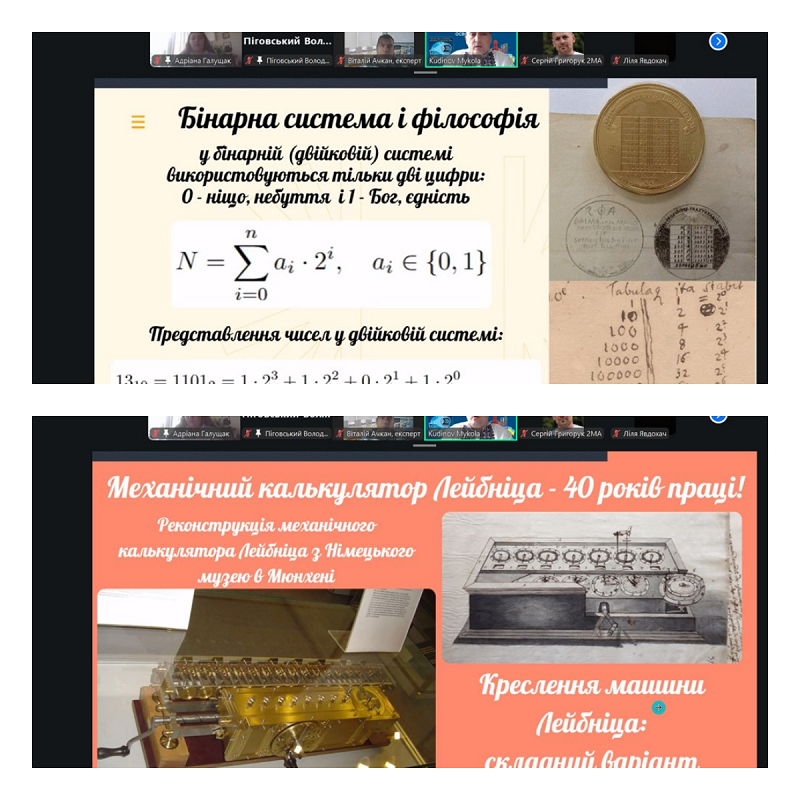
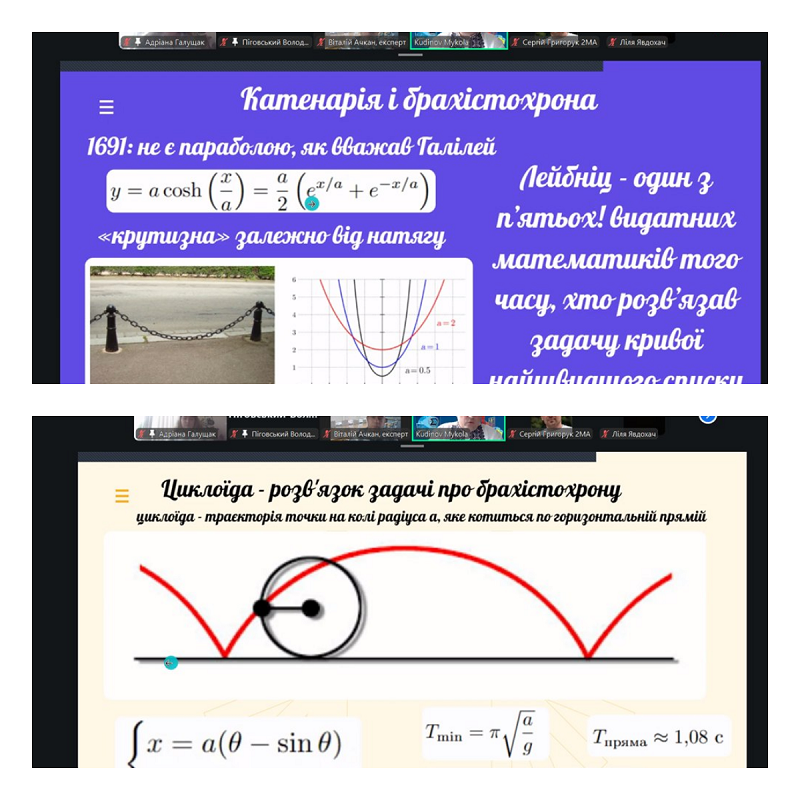
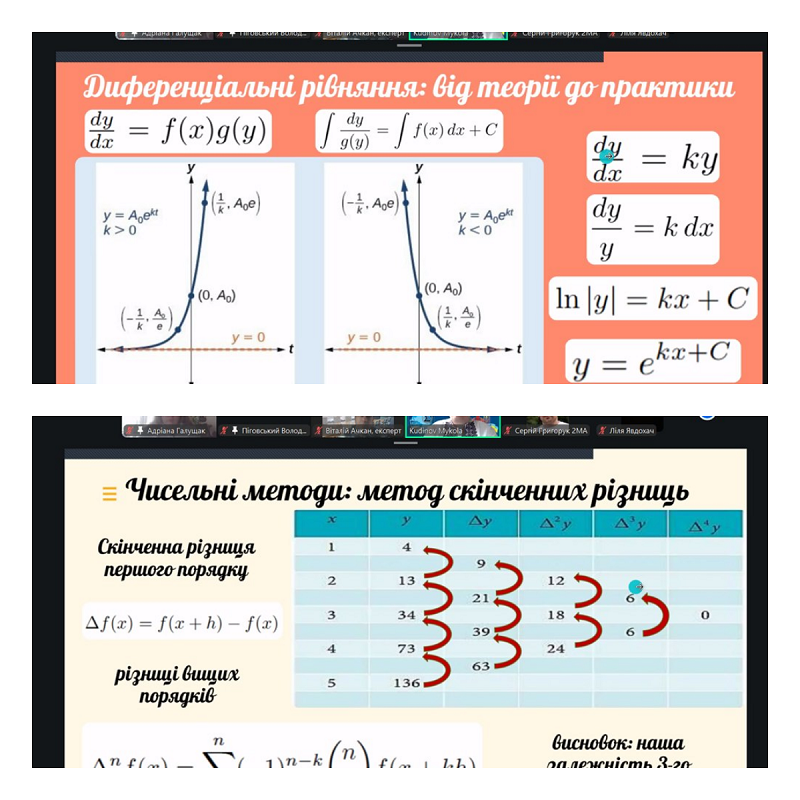
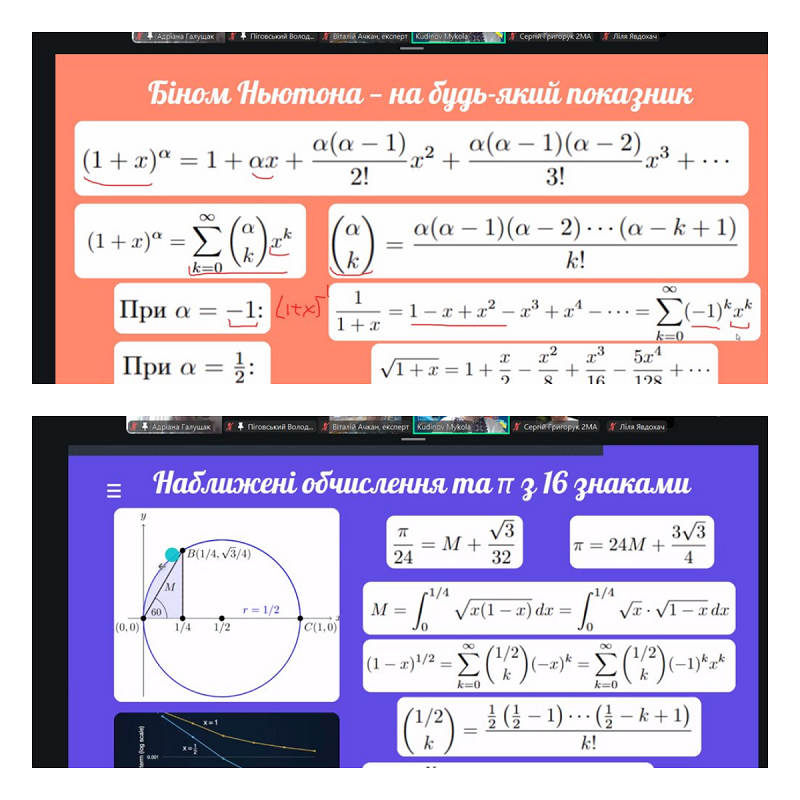
Першу частину лекції було присвячено математичним ідеям Готфріда Вільгельма Лейбніца та Ісаака Ньютона. Учасники ознайомилися зі значенням нескінченних рядів у розвитку математичного аналізу, розглянули відомі ряди Лейбніца: для числа π, а також телескопічний – для обернених трикутних чисел. Особливу увагу приділили біному Ньютона, який дав змогу по-новому поглянути на алгебраїчні залежності, узагальнити правила піднесення двочлена до натурального степеня та відкрив перспективи для подальшого розвитку математичних методів.
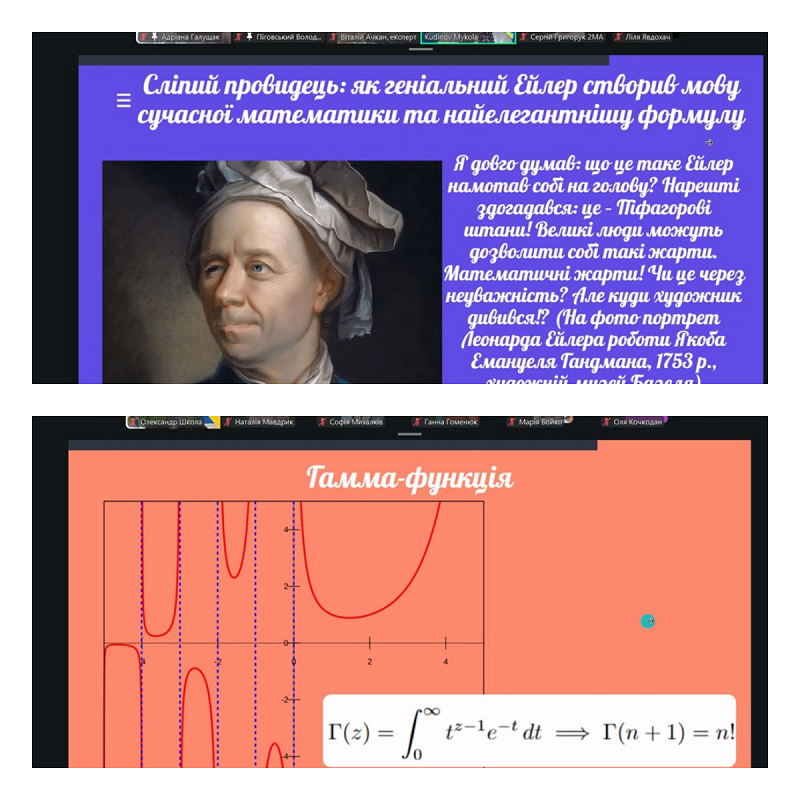
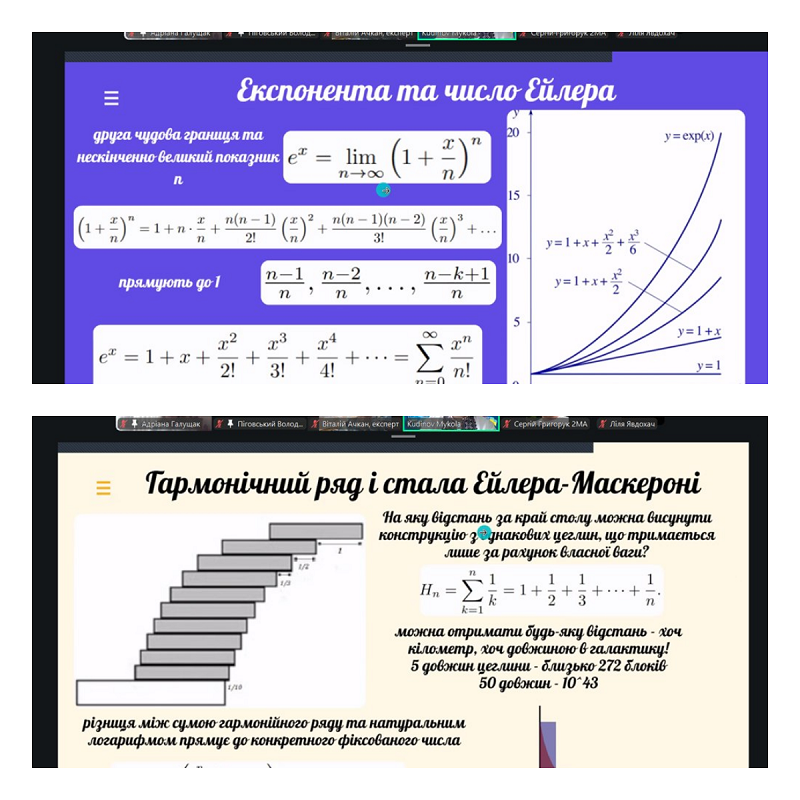
Особливе місце в лекції посіла постать Леонарда Ейлера – видатного математика, чиї ідеї й сьогодні залишаються невід’ємною частиною математичної науки. Його внесок охоплює надзвичайно широкий спектр математичних дисциплін: від теорії чисел і математичного аналізу до геометрії, механіки та математичної фізики. Слухачі простежили, як Ейлер упорядкував і розвинув математичну символіку, зробивши її мовою, якою науковці користуються й сьогодні. Зокрема, йшлося про позначення функції, числа e, уявної одиниці та інших фундаментальних математичних об’єктів.
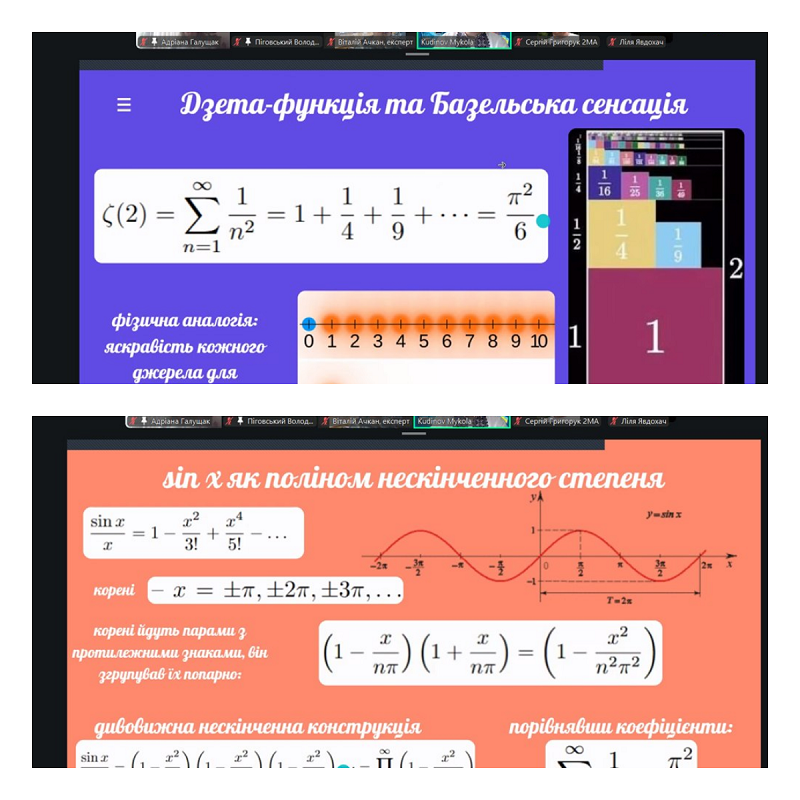
Окрему увагу було приділено знаменитій Базельській задачі, розв’язання якої продемонструвало надзвичайну силу аналітичних методів Ейлера. Учасники побачили, як сума обернених квадратів натуральних чисел привела до несподіваного зв’язку між нескінченними рядами та числом π. Цей приклад став яскравою ілюстрацією того, як абстрактні математичні міркування дають змогу знаходити точні результати в задачах, які тривалий час залишалися нерозв’язаними.
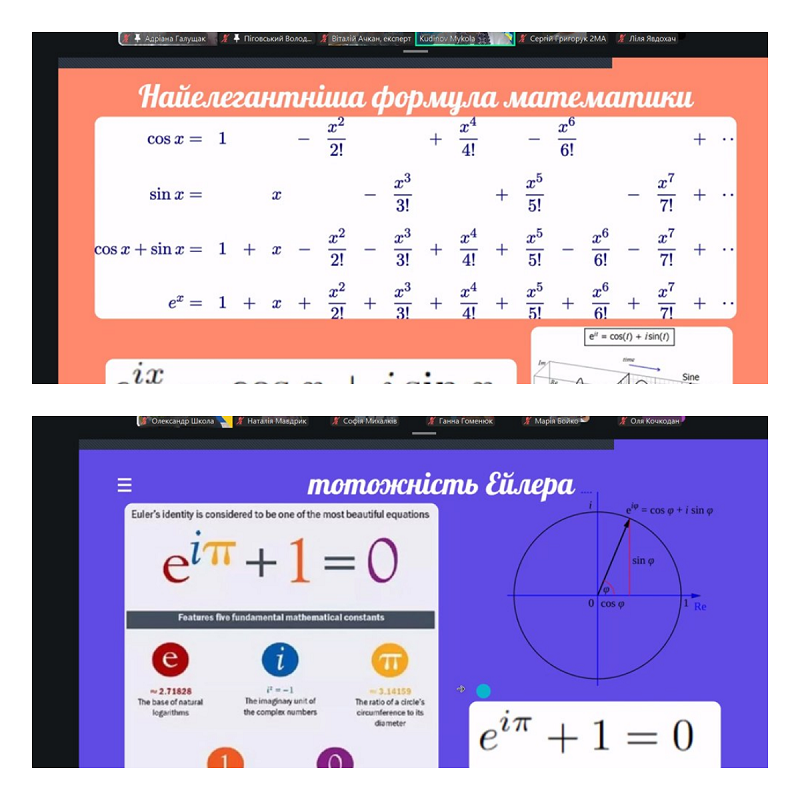
Не менш захопливою стала розмова про комплексні числа та уявну одиницю. Те, що спочатку здавалося незвичайним розширенням поняття числа, згодом перетворилося на один із найпотужніших інструментів математики, фізики та інженерії. Кульмінацією цієї частини лекції стала знаменита формула Ейлера, яка поєднує експоненту, тригонометричні функції та комплексні числа, а також її особливий випадок – тотожність Ейлера, яку часто називають однією з найелегантніших формул математики.
Упродовж лекції учасники мали змогу побачити не просто окремі математичні відкриття, а їхній взаємозв’язок і послідовність розвитку. Ідеї Лейбніца, Ньютона та Ейлера продемонстрували, як наукові здобутки різних епох доповнюють одне одного, розширюють можливості математичного пізнання та формують підґрунтя сучасної науки.
Такі зустрічі ще раз нагадують, що математика – це не лише формули, обчислення та розв’язування задач. Це захопливий пошук закономірностей, несподівані відкриття й краса логічної думки. За кожним математичним символом стоїть історія людського пошуку, а за кожною формулою – можливість побачити світ глибше.
На завершення зустрічі слова вдячності університетам-організаторам, лектору та всім учасникам висловили доктор педагогічних наук, професор, завідувач кафедри фізики, математики та методики навчання БДПУ Олександр Васильович Школа та кандидатка педагогічних наук, доцентка, завідувачка кафедри математики та методики її навчання ТНПУ імені Володимира Гнатюка Ганна Володимирівна Гоменюк.
Кафедра фізики, математики та методики навчання БДПУ й надалі розвиватиме співпрацю з українськими закладами вищої освіти, створюючи можливості для обміну досвідом, популяризації фундаментальних знань і залучення здобувачів до інтелектуального пошуку. Адже математика – це не тільки інструмент пізнання світу, а й особливий спосіб мислення, що допомагає ставити запитання, знаходити неочевидні зв’язки та відкривати нове.
Безкоштовний доступ до повної версії посібника: https://www.researchgate.net/publication/414227453
За матеріалами кафедри фізики, математики та методики навчання
Knowledge Shouldn’t Be on a Power-Outage Schedule: An Open Inter-University Lecture “From the Leibniz Series and Newton’s Binomial Theorem to Euler and the Imaginary Unit”
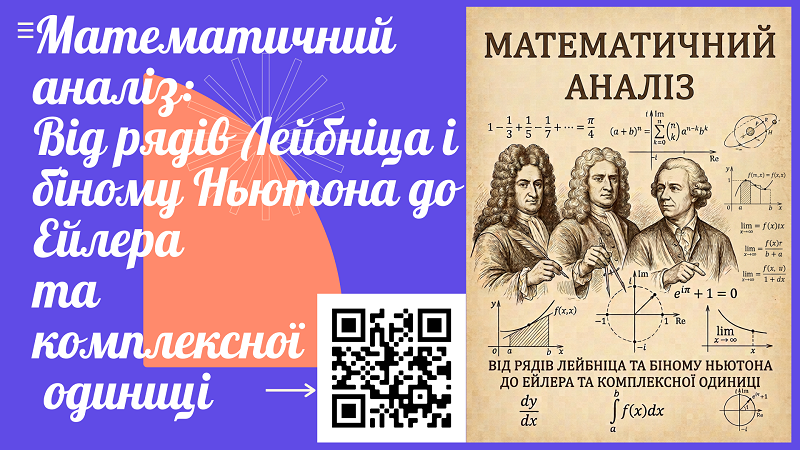
On November 4, an open lecture was held as part of inter-university cooperation. Entitled “Mathematical Analysis: From the Leibniz Series and Newton’s Binomial Theorem to Euler and the Imaginary Unit”, the event brought together students and academic staff from Berdyansk State Pedagogical University (BSPU) and Ternopil Volodymyr Hnatiuk National Pedagogical University (TNPU). The meeting offered not only an opportunity to immerse themselves in the fascinating world of mathematical ideas but also served as a presentation of the teaching and methodological handbook of the same title.
The lecture was delivered by Mykola Valeriiovych Kudinov, Associate Professor at the Department of Physics, Mathematics and Teaching Methods, Faculty of Physics, Mathematics, Computer and Technological Education at BDPU. He invited participants on an intellectual journey, from the first systematic studies of infinite series to the remarkable possibilities of complex numbers.
The first part of the lecture focused on the mathematical ideas of Gottfried Wilhelm Leibniz and Isaac Newton. Participants explored the importance of infinite series in the development of mathematical analysis and examined the well-known Leibniz series for the number π, as well as a telescoping series involving the reciprocals of triangular numbers. Particular attention was paid to Newton’s binomial theorem, which provided new insights into algebraic relationships, generalized the rules for raising a binomial to a natural-number power, and opened up new possibilities for the further development of mathematical methods.
Leonhard Euler, an outstanding mathematician whose ideas remain an integral part of mathematics to this day, occupied a special place in the lecture. His contributions span an extraordinarily wide range of mathematical disciplines, from number theory and mathematical analysis to geometry, mechanics, and mathematical physics. Participants explored how Euler systematized and developed mathematical notation, helping shape the language that mathematicians still use today. In particular, the discussion covered the notation for functions, the number e, the imaginary unit, and other fundamental mathematical concepts.
Special attention was devoted to the famous Basel problem, whose solution demonstrated the remarkable power of Euler’s analytical methods. Participants saw how the sum of the reciprocals of the squares of natural numbers revealed an unexpected connection between infinite series and the number π. This example vividly illustrated how abstract mathematical reasoning makes it possible to obtain exact results for problems that had remained unsolved for a long time.
The discussion of complex numbers and the imaginary unit was equally fascinating. What initially seemed to be an unusual extension of the concept of number eventually became one of the most powerful tools in mathematics, physics, and engineering. The highlight of this part of the lecture was Euler’s famous formula, which connects the exponential function, trigonometric functions, and complex numbers, as well as its special case – Euler’s identity, often regarded as one of the most elegant formulas in mathematics.
Throughout the lecture, participants had the opportunity to see not merely individual mathematical discoveries, but also the connections between them and the sequence of their development. The ideas of Leibniz, Newton, and Euler demonstrated how scientific achievements from different eras complement one another, expand the possibilities of mathematical inquiry, and lay the foundations of modern science.
Such meetings remind us once again that mathematics is not merely about formulas, calculations, and solving problems. It is a fascinating search for patterns, unexpected discoveries, and the beauty of logical thought. Behind every mathematical symbol lies a story of human inquiry, and behind every formula is an opportunity to see the world more deeply.
At the end of the meeting, words of appreciation to the organizing universities, the lecturer, and all participants were expressed by Oleksandr Vasylovych Shkola, Doctor of Pedagogical Sciences, Professor and Head of the Department of Physics, Mathematics and Teaching Methods at BSPU, and Hanna Volodymyrivna Homeniuk, Candidate of Pedagogical Sciences, Associate Professor and Head of the Department of Mathematics and Teaching Methods at TNPU.
The Department of Physics, Mathematics and Teaching Methods at BDPU will continue to develop cooperation with Ukrainian higher education institutions, creating opportunities for the exchange of experience, the promotion of fundamental knowledge, and the engagement of students in intellectual inquiry. After all, mathematics is not only a tool for understanding the world, but also a distinctive way of thinking that helps us ask questions, discover unexpected connections, and explore the unknown.
Free access to the full version of the book: https://www.researchgate.net/publication/414227453
