
13 листопада 2026 року на базі кафедри іноземних мов і методики викладання відбулося чергове засідання студентського наукового гуртка «Іноземні мови в сучасному світі», участь у якому беруть здобувачі вищої освіти бакалаврських освітніх програм «Філологія (германські мови та літератури (переклад включно), перша – англійська, друга – німецька)» та «Середня освіта (англійська мова та література)», а також магістерської ОП «Середня освіта (мова і література (англійська))». Керівником гуртка є кандидат філологічних наук, доцент Мороз А. А.
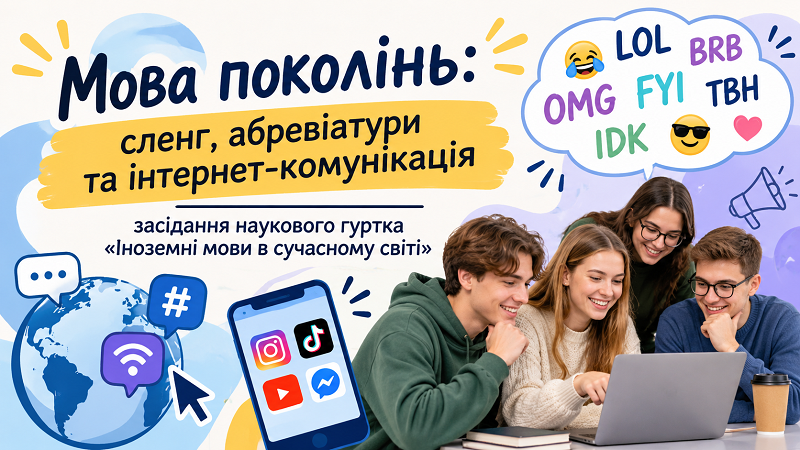
Тема засідання – «Мова поколінь: сленг, абревіатури та інтернет-комунікація».
Під час зустрічі було розглянуто особливості сучасного англомовного сленгу та його функціонування в цифровому середовищі. Особливу увагу приділено мовним тенденціям, характерним для соціальних мереж, месенджерів та інших платформ інтернет-комунікації. Студенти ознайомилися з поширеними англомовними абревіатурами, скороченнями, інтернет-мемами та емодзі, які стали невід’ємними елементами повсякденного спілкування представників різних поколінь.
У межах засідання було проаналізовано приклади сучасного сленгу з англомовних соціальних мереж і медіа, розглянуто особливості виникнення та поширення нових лексичних одиниць, а також їхню роль у формуванні молодіжного мовлення. Окрему увагу приділено взаємозв’язку між мовою, віком, соціальним середовищем та цифровою культурою.
Інтерактивна частина зустрічі передбачала обговорення актуальних прикладів інтернет-комунікації, тлумачення популярних скорочень і сленгових виразів, а також порівняння традиційних і сучасних моделей спілкування. Студенти висловлювали власні міркування щодо впливу цифрових технологій на англійську мову та дискутували над питанням: чи змінює інтернет-комунікація мовні норми, чи лише створює нові можливості для самовираження?
Засідання мало пізнавальний та інтерактивний характер, сприяло розширенню лексичного запасу здобувачів освіти, розвитку навичок аналізу сучасних мовних явищ і формуванню соціокультурної компетентності майбутніх філологів і вчителів англійської мови.
Проведений захід у межах діяльності студентського наукового гуртка засвідчив важливість дослідження сучасних тенденцій розвитку англійської мови та її функціонування в цифровому просторі. Подібні зустрічі дають студентам можливість не лише поглиблювати теоретичні знання, а й краще розуміти динаміку мовних змін, пов’язаних із розвитком сучасного суспільства та новітніх засобів комунікації.
Мороз А. А., доцент
кафедри іноземних мов і методики викладання
“The Language of Generations: Slang, Abbreviations, and Internet Communication” – A Meeting of the Student Research Group “Foreign Languages in the Modern World”
On November 13, 2026, the Department of Foreign Languages and Teaching Methodology hosted a meeting of the student research group “Foreign Languages in the Modern World.” Participants included students from the Bachelor’s degree programs “Philology (Germanic languages and literatures (including translation), English major, German minor)” and “Secondary Education (English Language and Literature),” as well as the Master’s degree program “Secondary Education (Language and Literature (English)).” The group is led by A. A. Moroz, Candidate of Philological Sciences and Associate Professor.
The theme of the meeting was “The Language of Generations: Slang, Abbreviations, and Internet Communication.”
During the session, the participants examined the characteristics of contemporary English-language slang and its role within the digital environment. Particular attention was paid to linguistic trends prevalent on social networks, messaging apps, and other online communication platforms. Students explored common English-language abbreviations, acronyms, internet memes, and emojis – elements that have become integral to the everyday communication of people across different generations. During the session, participants analyzed examples of contemporary slang from English-language social media and other media, examined the origins and spread of new lexical units, and explored their role in shaping the language used by young people. Special attention was given to the interplay between language, age, social environment, and digital culture.
The interactive segment of the meeting included discussions on current examples of online communication, the interpretation of popular abbreviations and slang expressions, and a comparison between traditional and modern modes of interaction. Students shared their perspectives on the impact of digital technologies on the English language and debated whether online communication alters linguistic norms or simply creates new avenues for self-expression.
The session was both informative and interactive; it helped students expand their vocabulary, develop skills for analyzing contemporary linguistic phenomena, and build the sociocultural competence essential for future philologists and English language teachers.
This event, organized as part of the student research group’s activities, highlighted the importance of studying current trends in the evolution of the English language and its functioning within the digital sphere. Such meetings offer students the opportunity not only to deepen their theoretical knowledge but also to gain a better understanding of the dynamics of linguistic change as driven by the evolution of modern society and cutting-edge communication tools.
A. A. Moroz, Associate Professor,
Department of Foreign Languages and Teaching Methodology
