29 квітня відбулося чергове засідання студентського наукового гуртка кафедри соціальної роботи та інклюзивної освіти «Соціалізація дітей і молоді в умовах сучасного соціокультурного простору» (керівниця – доцентка Наталя Захарова). Цього разу зустріч набула особливого змістового наповнення — вона стала простором не лише для обговорення, а й для переосмислення власного досвіду, наукових орієнтирів і внутрішніх ресурсів.
Діяльність гуртка традиційно ґрунтується на принципі відкритості до інтересів здобувачів. Тут народжуються ідеї, які поєднують особистий досвід із науковим пошуком, формують критичне мислення, дослідницьку культуру та здатність бачити глибші сенси у звичних соціальних процесах.
Тематика зустрічі – «Соціалізація як чинник наукової діяльності» та рубрика «Наука відкриває світ» – задала тон глибокій і водночас рефлексивній розмові. Модераторка наголосила: соціалізація – це не просто фон життя, а динамічний процес, у якому формується наукове мислення, здатність до діалогу, творчості та інтелектуальної взаємодії.
Учасники відзначили, що людина часто не усвідомлює, як щоденно проживає стани адаптації й дезадаптації, прийняття й відторгнення, пошуку й сумнівів. Саме ці внутрішні процеси стають підґрунтям для особистісного та професійного зростання.
Особливого змісту зустрічі надала інтерактивна частина: здобувачі ділилися власними історіями соціалізації, пригадували ситуації, що вимагали гнучкості, витримки, пошуку нових стратегій. Як зазначила одна з учасниць:
«Я вперше подивилася на свій досвід не як на труднощі, а як на ресурс, який уже працює на мене».
У контексті наукової діяльності було проаналізовано історії відомих учених — Ісаак Ньютон, Альберт Ейнштейн, Нікола Тесла, Марія Склодовська-Кюрі. Їхні життєві шляхи переконливо демонструють: навіть складні соціальні обставини можуть стати каталізатором відкриттів, якщо людина знаходить внутрішній ресурс і не втрачає інтересу до пізнання.
Логічним підсумком стало усвідомлення: кожен має власну траєкторію розвитку, а бар’єри – це не зупинки, а точки росту.
Окремий інтерес викликала рубрика «Наука відкриває світ», де звучать історії викладачів-науковців кафедри соціальної роботи та інклюзивної освіти. Попередні зустрічі запам’яталися натхненними виступами професорки Ольги Гуренко та доцентки Анастасії Попової, які акцентували: наука – це шлях наполегливості, готовності діяти та бачити можливості навіть у випадковостях.
Цього разу у фокусі уваги була кандидатка педагогічних наук, доцентка, завідувачка кафедри Катерина Петровська. У форматі авторського методу вона представила метафору «Ріки» – власного життєвого та наукового шляху:
- досліджувати, щоб відкривати нове;
- працювати з людьми, щоб створювати зміни;
- ділитися досвідом, що надихає;
- рухатися вперед, не зупиняючись.
Її настанови для молодих науковців стали своєрідним орієнтиром:
- наука – це сміливість мислення і щоденна праця;
- наука – це не ізольованість, а спільнота;
- кожен має свій шлях і свої вершини;
- маленькі кроки формують великі результати;
- правильний шлях – той, що веде вперед.
Як підкреслили учасники, саме такі зустрічі «олюднюють» науку, роблять її ближчою і зрозумілішою: «Коли чуєш живу історію, з’являється відчуття, що і ти можеш пройти цей шлях».
Ідея популяризації науки через особистісні історії отримала щирий відгук серед здобувачів. Вона не лише змінює уявлення про постать викладача-науковця, а й допомагає побачити реальні, досяжні моделі професійного становлення.
Проведене засідання вкотре підтвердило: студентський науковий гурток – це не просто освітній формат, а живий простір розвитку, де народжується інтерес до дослідження, формується професійна ідентичність і відкривається власний шлях у науці.
За матеріалами кафедри соціальної роботи та інклюзивної освіти
Small Steps Towards Big Ideas: Socialisation Leading to Science
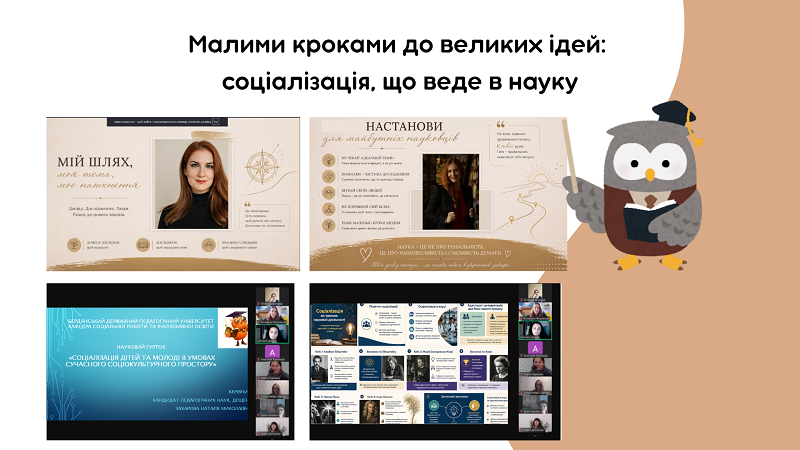
On April 29, another meeting of the student scientific club of the Department of Social Work and Inclusive Education, “Socialisation of Children and Youth in the Contemporary Socio-Cultural Space” (supervised by Associate Professor Nataliia Zakharova), took place. This time, the meeting acquired a special depth, becoming a space not only for discussion but also for rethinking personal experience, scientific orientations, and internal resources.
The club’s activities are traditionally based on openness to students’ interests. It is a space where ideas emerge at the intersection of personal experience and scientific inquiry, fostering critical thinking, research culture, and the ability to identify deeper meanings within everyday social processes.
The theme of the meeting, “Socialisation as a Factor in Scientific Activity,” along with the section “Science Opens the World,” set the tone for a meaningful and reflective discussion. The moderator emphasised that socialisation is not merely a background to life but a dynamic process in which scientific thinking, dialogue, creativity, and intellectual interaction are formed.
Participants noted that individuals often do not realise how they continuously experience states of adaptation and maladaptation, acceptance and rejection, search and doubt. These internal processes become the foundation for both personal and professional growth.
The interactive part of the meeting added particular value: students shared their own socialisation stories, recalling situations that required flexibility, resilience, and the search for new strategies. As one participant noted:
“For the first time, I saw my experience not as a difficulty, but as a resource that is already working for me.”
Within the context of scientific activity, the life stories of prominent scholars – Isaac Newton, Albert Einstein, Nikola Tesla, and Marie Skłodowska-Curie – were analysed. Their life paths convincingly demonstrate that even challenging social circumstances can become catalysts for discovery if a person finds internal resources and maintains a curiosity for knowledge.
A logical conclusion emerged: everyone has their own trajectory of development, and barriers are not stopping points but opportunities for growth.
Special interest was drawn to the section “Science Opens the World,” where stories of academic staff from the Department of Social Work and Inclusive Education are presented. Previous meetings featured inspiring talks by Professor Olha Hurenko and Associate Professor Anastasiia Popova, who emphasised that science is a path of perseverance, readiness to act, and the ability to see opportunities even in случайностях.
This time, the focus was on Candidate of Pedagogical Sciences, Associate Professor, and Head of the Department Kateryna Petrovska. Through her original method, she presented the metaphor of a “River” as her life and scientific journey:
- to explore in order to discover new knowledge;
- to work with people in order to create change;
- to share inspiring experience;
- to keep moving forward without stopping.
Her key messages for young researchers became guiding principles:
- science is courage of thought and daily work;
- science is not isolation, but community;
- everyone has their own path and their own вершини;
- small steps create big results;
- the right path is the one that leads forward.
As participants highlighted, such meetings “humanise” science, making it closer and more understandable: “When you hear a real story, you start to feel that you can walk this path too.”
The idea of popularising science through personal stories received a strong response among students. It not only reshapes perceptions of academics but also helps to see real and achievable models of professional development.
The meeting once again confirmed that a student scientific club is not just an educational format but a living space for development, where interest in research is born, professional identity is shaped, and one’s own path in science is discovered.
Based on materials from the Department of Social Work and Inclusive Education
