
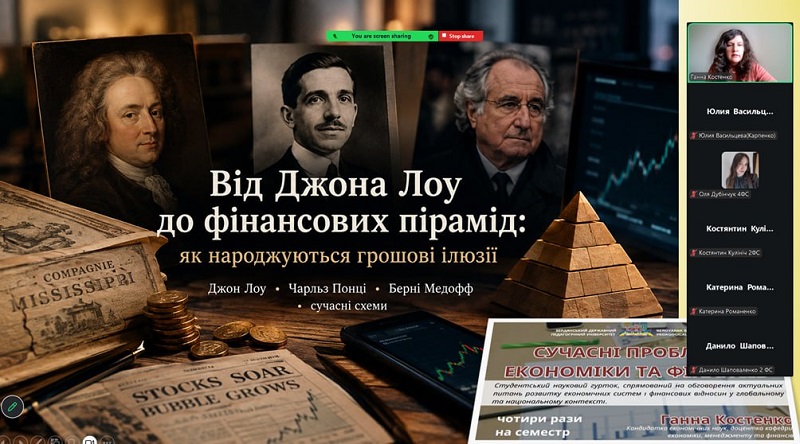
30 вересня 2026 року відбулося чергове, але перше у новому 2026-2027 навчальному році, засідання наукового гуртка «Сучасні проблеми економіки та фінансів», організоване кафедрою економіки, менеджменту та фінансів Бердянського державного педагогічного університету. Під час засідання учасники розглянули історичні приклади виникнення фінансових бульбашок та схем, що ґрунтуються на залученні коштів нових учасників, а також проаналізували роль довіри, очікувань та поведінки інвесторів у розвитку таких фінансових процесів.
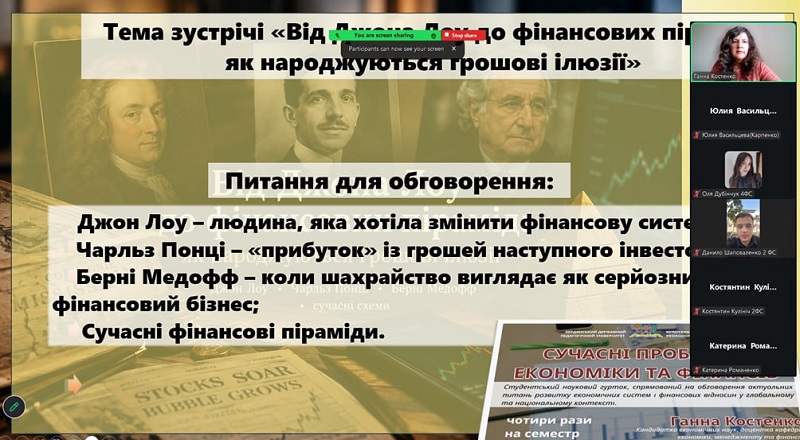
Під час зустрічі увагу було зосереджено на постаті Джона Лоу – шотландського фінансиста XVIII століття, який прагнув змінити фінансову систему та використовував нові підходи до організації грошового обігу. На прикладі Mississippi Bubble учасники розглянули механізми стрімкого зростання вартості активів та взаємозв’язок між очікуваннями інвесторів, довірою до фінансової системи й динамікою цін. Окремо було наголошено на важливому розмежуванні між фінансовою бульбашкою та класичною фінансовою пірамідою.
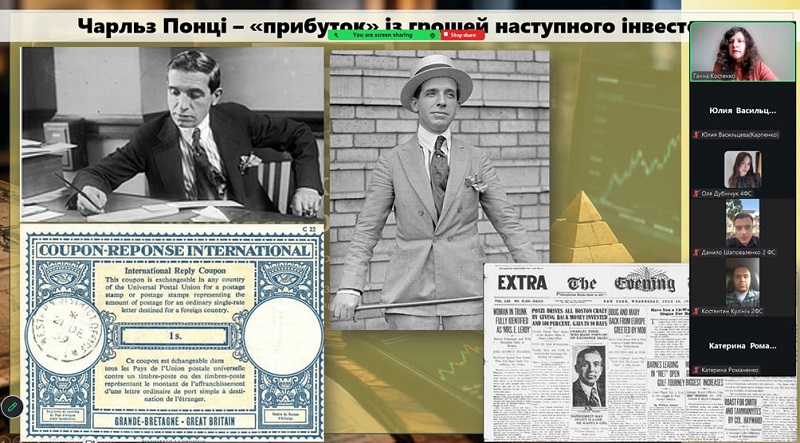
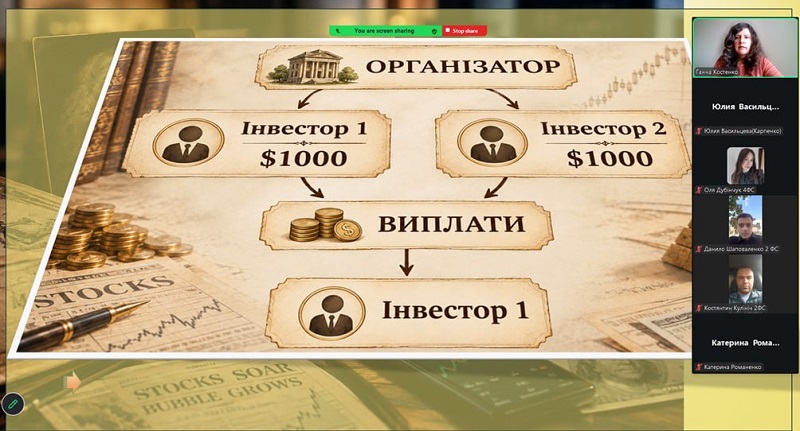
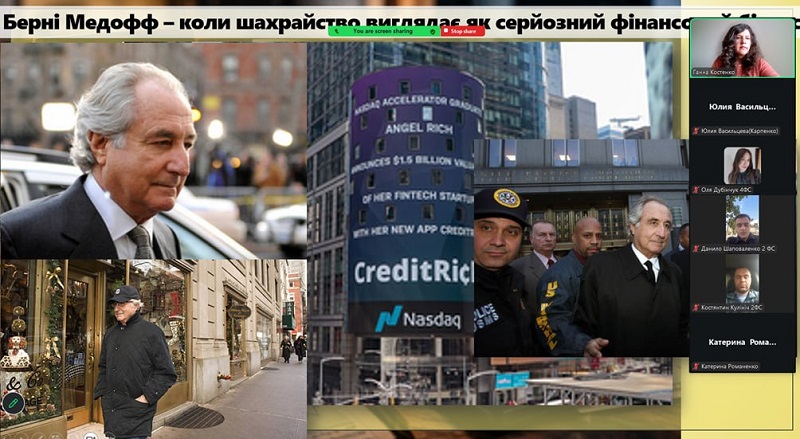
Значну увагу було приділено історії Чарльза Понці та механізму функціонування Ponzi-схеми, за якої виплати раннім учасникам здійснюються за рахунок коштів пізніших учасників, а не реального інвестиційного прибутку. Учасники також розглянули справу Берні Медоффа як приклад масштабної фінансової схеми, яка тривалий час сприймалася як діяльність серйозного фінансового бізнесу. Обговорення дозволило простежити спільні механізми, завдяки яким фінансові схеми можуть підтримувати довіру учасників доти, доки продовжується приплив нових коштів. Окремий блок зустрічі було присвячено сучасним фінансовим пірамідам та ознакам потенційно небезпечних фінансових пропозицій. У практичній частині учасники аналізували конкретні ситуації, пов’язані з обіцянками гарантованої високої дохідності, необхідністю термінового прийняття рішення та залученням нових учасників як основного джерела доходу.
Тематика засідання є актуальною для здобувачів освітньо-професійних програм «Фінанси, банківська справа та страхування» та «Економіка бізнесу», оскільки дозволяє поглибити знання щодо функціонування фінансових ринків, особливостей інвестиційної поведінки та фінансових ризиків. Аналіз історичних прикладів сприяє формуванню критичного та аналітичного мислення, розвитку навичок оцінювання фінансової інформації та розуміння необхідності перевірки джерел отримання інвестиційного доходу.
Керівник наукового гуртка – к.е.н., доцент кафедри економіки, менеджменту та фінансів Ганна Костенко – наголосила на важливості вивчення історичного досвіду функціонування фінансових систем та аналізу механізмів виникнення фінансових ілюзій.

За матеріалами
Ганни Костенко, доцента кафедри економіки, менеджменту та фінансів
From financial bubbles to modern financial pyramids: money illusions and lessons from history in focus of the scientific club “Current issues of economics and finance”

On September 30, 2026, the next meeting of the Scientific club “Current Issues of Economics and Finance” was held. It was the first meeting of the new 2026–2027 academic year and was organized by the Department of Economics, Management and Finance of Berdyansk State Pedagogical University. During the meeting, participants examined historical examples of financial bubbles and schemes based on attracting funds from new participants, as well as analyzed the role of trust, expectations, and investor behavior in the development of such financial processes.
During the meeting, particular attention was devoted to John Law, an 18th-century Scottish financier who sought to transform the financial system and introduced innovative approaches to the organization of monetary circulation. Using the Mississippi Bubble as an example, participants examined the mechanisms behind the rapid increase in asset values and the relationship between investor expectations, confidence in the financial system, and price dynamics. Particular emphasis was placed on the important distinction between a financial bubble and a classic financial pyramid scheme.
Considerable attention was devoted to the history of Charles Ponzi and the mechanism of a Ponzi scheme, in which payments to early participants are made using funds provided by later participants rather than from actual investment returns. Participants also examined the case of Bernie Madoff as an example of a large-scale financial scheme that was perceived for a long time as the activity of a legitimate and established financial business. The discussion made it possible to trace the common mechanisms through which financial schemes can maintain participants’ trust as long as the inflow of new funds continues.
A separate part of the meeting focused on modern financial pyramid schemes and the warning signs of potentially dangerous financial offers. During the practical part, participants analyzed specific situations involving promises of guaranteed high returns, pressure to make an immediate decision, and the recruitment of new participants as the primary source of income.
The topic of the meeting is particularly relevant to students enrolled in the educational and professional programs “Finance, Banking and Insurance” and “Business Economics”, as it provides an opportunity to deepen their knowledge of the functioning of financial markets, investment behavior, and financial risks. The analysis of historical examples contributes to the development of critical and analytical thinking, enhances students’ ability to evaluate financial information, and promotes an understanding of the importance of verifying the sources of investment returns.
The scientific club supervisor, Hanna Kostenko, PhD in Economics, Associate Professor of the Department of Economics, Management and Finance, emphasized the importance of studying the historical experience of financial systems and analyzing the mechanisms underlying the emergence of financial illusions.
Based on materials by
Ganna Kostenko, Associate Professor
Department of Economics, Management and Finance
