У сучасних умовах Україна відновлюється не лише інфраструктурно – відбувається значно глибший процес: відновлення людських життів, зв’язків і сенсів. У цьому процесі соціальна робота стає однією з ключових професій, що поєднує підтримку, емпатію і професійну дію.
Саме таких фахівців готує освітньо-професійна програма «Поствоєнна соціально-психологічна реінтеграція». І якщо аудиторія дає знання, то виробнича практика стає тим середовищем, де ці знання проходять перевірку реальністю.
Цьогорічна практика магістрантів заочної форми навчання спеціальності І10 «Соціальна робота та консультування» вкотре засвідчила: сучасний здобувач – це не просто студент, а доросла, часто вже професійно сформована особистість, яка приходить у нову сферу, щоб розширити власні можливості допомоги людям.
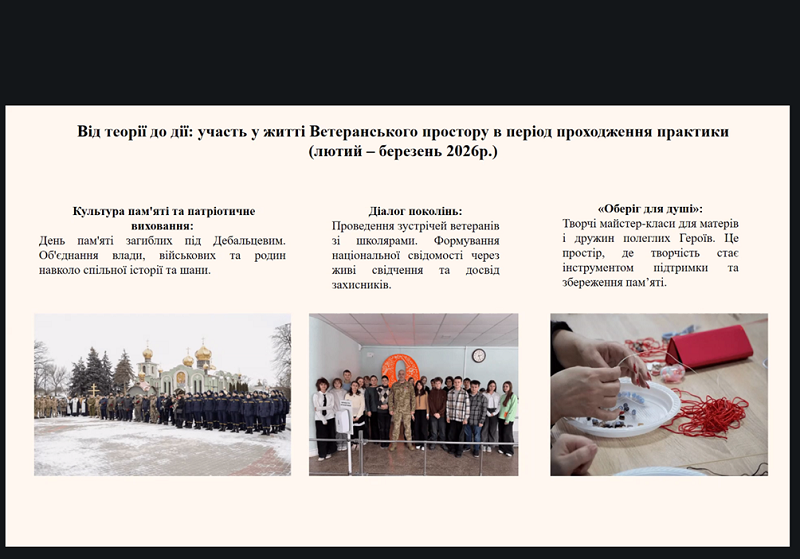
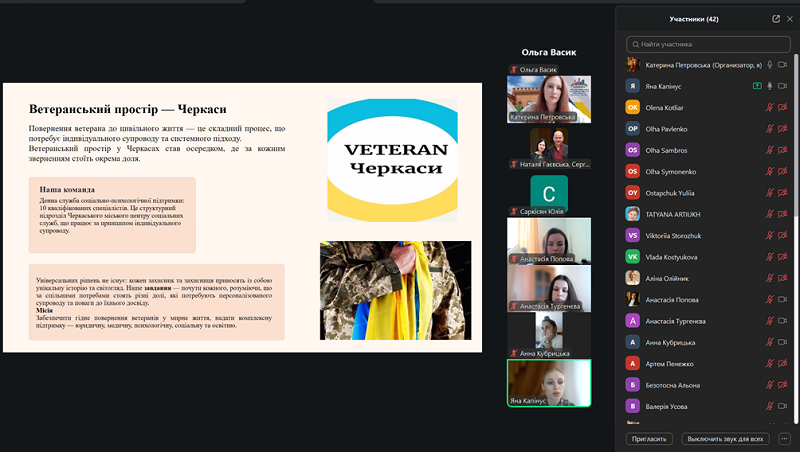
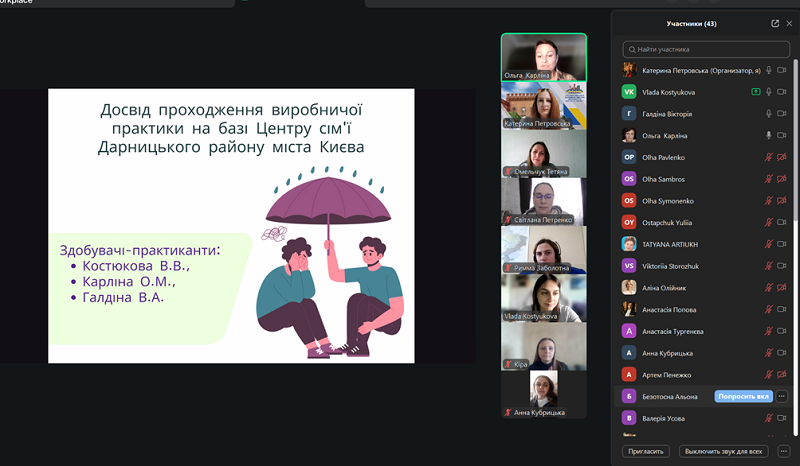
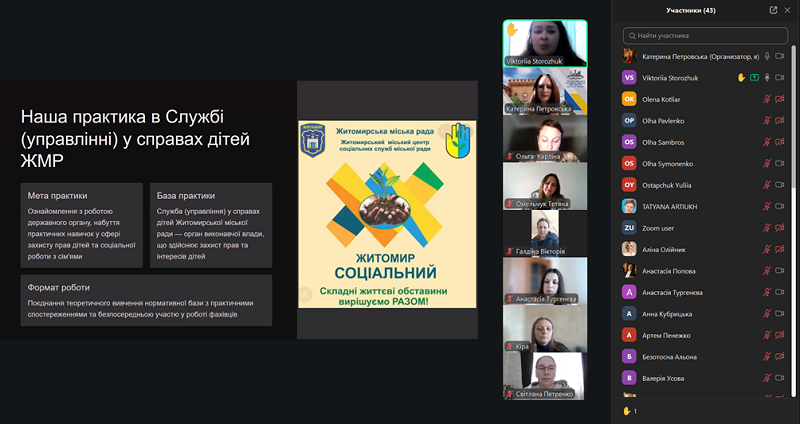
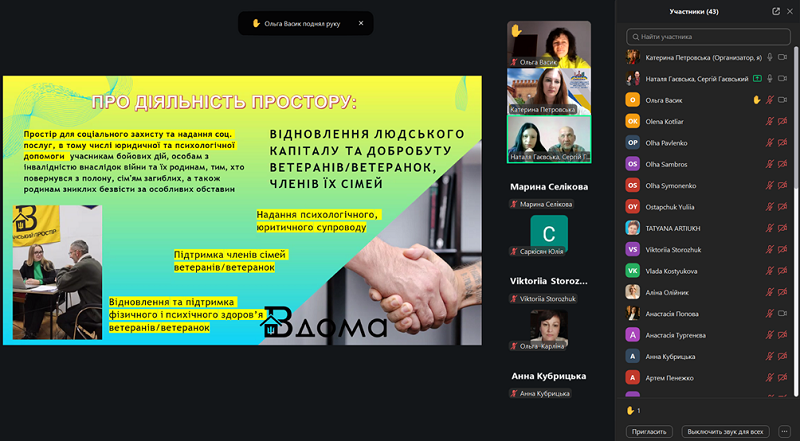
Географія цьогорічної практики охоплювала різні регіони України та широкий спектр установ: від центрів соціальних служб і реабілітаційних установ до підрозділів поліції, ветеранських просторів і громадських організацій. Проте найважливішим є не місце, а досвід, який отримують здобувачі – досвід зустрічі з реальністю людських історій.
Одна з магістранток, розпочинаючи практику у відділі з питань ветеранської політики, йшла туди з чітким професійним запитом – апробувати методики для магістерського дослідження. Проте, як вона сама зізнається, реальність виявилася значно глибшою:
«Я очікувала зустрічі з “клієнтами”, а зустріла долі, які вимагали не лише професійних алгоритмів, а й глибокої людської присутності».
Цей досвід став для неї точкою внутрішньої трансформації – переходом від ролі викладача до ролі фахівця, який не лише навчає, а й розділяє біль і допомагає відновлювати ресурс.
За словами магістрантів особливо емоційно насиченою стала робота з дітьми, які пережили втрати або були змушені покинути свої домівки. Тут змінюється сама логіка взаємодії:
«Я зрозуміла, що в очах дитини, яка бачила обстріли, я маю бути не “методистом”, а провідником у безпечний простір».
Через творчість, гру, спільні заходи народжується довіра — а разом із нею і можливість говорити про пережите. Символічним для практикантки став момент взаємодії дітей із військовими:
«Бачити, як дитина, що втратила батька, довірливо бере за руку військового – це і є соціальна робота в її найглибшому сенсі. Це відновлення зв’язків».
Не менш складним виявився досвід роботи з ветеранами та їхніми родинами. Тут соціальна робота стикається з питаннями ідентичності, гідності та прийняття нової реальності:
«Я зіткнулася з феноменом втраченої ідентичності. Моє завдання було не жаліти, а бути партнером у відбудові нового життя».
Такий досвід формує нове розуміння професії: соціальний працівник – це не лише надавач послуг, а співучасник процесу відновлення.
Практика стала для здобувачів моментом професійного переосмислення. Вони говорили про важливість емпатії, командної роботи, здатності швидко реагувати в кризових умовах і водночас зберігати людяність.
Аналіз звітів із практики показує: магістранти демонструють високий рівень рефлексії, готовність працювати з різними категоріями клієнтів і здатність поєднувати теоретичні знання з практичними діями. Важливо, що багато з них уже сьогодні інтегрують результати практики у власні дослідження, перевіряючи ефективність підходів у реальних кейсах.
Практика стає не просто частиною освітнього процесу – вона перетворюється на простір формування професійної ідентичності. Саме тут з’являється усвідомлення: соціальна робота в поствоєнний період – це про відновлення не лише людей, а й сенсів.
Як зазначає одна зі студенток:
«Соціальний працівник сьогодні – це архітектор людських душ, який допомагає з уламків будувати нове життя».
І, мабуть, саме ця думка найточніше передає сутність того, що відбувається під час практики. Наші магістранти вже сьогодні є частиною великого процесу відновлення країни. Вони працюють там, де болить, де складно, де потрібна підтримка. І саме через цю щоденну роботу формується майбутнє – більш стійке, більш людяне, більш свідоме.
Соціальна робота – це не просто професія. Це вибір бути поруч. І цей вибір наші студенти вже зробили. Кожна практика – це не лише сторінка в навчальному плані, а й розділ у великій історії становлення нової України. Історії, яку вже сьогодні творять наші студенти – ті, хто не чекає змін, а сам є цими змінами. І нехай попереду ще багато викликів, але ми впевнені – в руках таких фахівців майбутнє нашої країни буде людяним, сильним і справедливим.
Ми віримо: у кожного з наших студентів – місія. І кожен із них уже зараз готовий її виконувати. Тому що соціальна робота – це не просто професія. Це поклик серця. Це – про Людину.
Поки ЗСУ виборює свободу на фронті, наші студенти виборюють її у тилу – допомагаючи зцілювати душі, підтримувати сім’ї, відновлювати громади. Разом – до Перемоги. І далі – до відновленої, сильної України.
За матеріалами кафедри соціальної роботи та інклюзивної освіти
Master’s Practicum as an Experience that Reinterprets the Profession
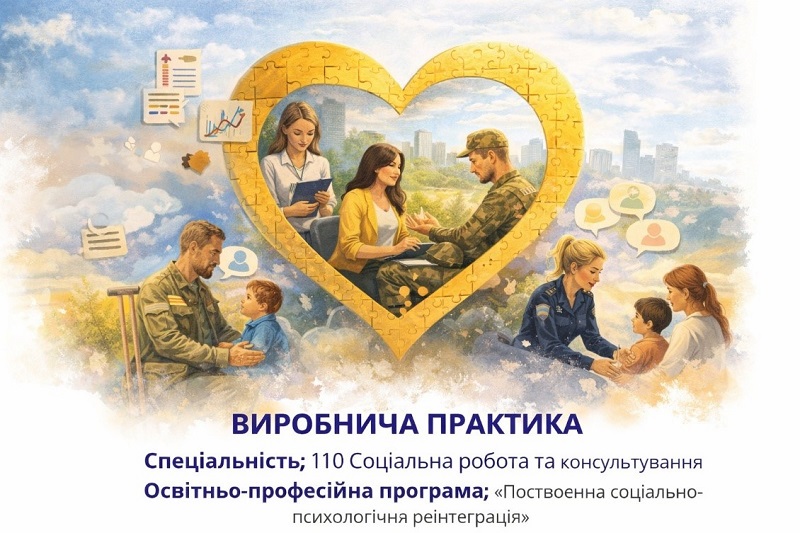
In today’s context, Ukraine is undergoing not only infrastructural recovery – a much deeper process is taking place: the restoration of human lives, relationships, and meanings. In this process, social work is becoming one of the key professions that combines support, empathy, and professional action.
It is precisely such specialists who are trained within the educational-professional program “Post-war Socio-Psychological Reintegration.” If the classroom provides knowledge, then the practicum becomes the environment where this knowledge is tested by reality.
This year’s practicum of part-time master’s students in specialty I10 “Social Work and Counseling” once again demonstrated that a modern student is not merely a learner, but an adult, often already professionally formed individual who enters a new field to expand their capacity to help others.
The geography of this year’s practicum covered various regions of Ukraine and a wide range of institutions: from social service centers and rehabilitation facilities to police units, veteran spaces, and non-governmental organizations. However, the most important aspect is not the location itself, but the experience students gain – the experience of encountering real human stories.
One of the master’s students, beginning her practicum in a department of veterans’ policy, entered it with a clear professional objective – to test methods for her master’s research. However, as she herself admits, reality turned out to be much deeper:
“I expected to meet ‘clients,’ but I met lives that required not only professional algorithms, but also deep human presence.”
This experience became a point of inner transformation for her – a shift from the role of an instructor to the role of a practitioner who not only applies knowledge but also shares pain and helps restore resources.
According to the students, work with children who had experienced loss or were forced to leave their homes was particularly emotionally intense. Here, the logic of interaction itself changes: “I realized that in the eyes of a child who has witnessed shelling, I must not be a ‘methodologist,’ but a guide to a safe space.”
Through creativity, play, and shared activities, trust is formed – and with it, the possibility to speak about traumatic experiences. A symbolic moment for one practicum student was an interaction between children and military personnel: “To see a child who lost a father confidently take a soldier’s hand – this is social work in its deepest sense. It is the restoration of connections.”
No less challenging was the experience of working with veterans and their families. Here, social work confronts issues of identity, dignity, and acceptance of a new reality: “I encountered the phenomenon of a lost identity. My task was not to pity, but to be a partner in rebuilding a new life.”
Such experience shapes a new understanding of the profession: a social worker is not only a service provider, but a co-participant in the process of recovery.
The practicum became a moment of professional rethinking for students. They spoke about the importance of empathy, teamwork, the ability to respond quickly in crisis conditions, and at the same time maintain humanity.
Analysis of practicum reports shows that master’s students demonstrate a high level of reflection, readiness to work with different categories of clients, and the ability to integrate theoretical knowledge with practical action. Importantly, many of them are already integrating practicum results into their own research, testing the effectiveness of approaches in real-life cases.
The practicum becomes not just a part of the educational process – it transforms into a space for the formation of professional identity. It is here that the understanding emerges: social work in the post-war period is about restoring not only people, but also meanings.
As one student notes: “A social worker today is an architect of the human soul, helping to build a new life from fragments.”
And perhaps this idea most accurately captures the essence of what happens during the practicum. Our master’s students are already part of the country’s great recovery process. They work where it hurts, where it is difficult, where support is needed. And it is through this daily work that the future is being shaped – more resilient, more humane, more conscious.
Social work is not just a profession. It is a choice to be present. And this choice has already been made by our students. Each practicum is not only a page in an academic curriculum, but also a chapter in the larger story of building a new Ukraine – a story already being written by our students, those who do not wait for change but become it.
There are still many challenges ahead, but we are confident: in the hands of such professionals, the future of our country will be humane, strong, and just.
We believe that each of our students has a mission. And each of them is already ready to fulfill it. Because social work is not just a profession – it is a calling of the heart. It is about Humanity.
While the Armed Forces of Ukraine fight for freedom on the front line, our students fight for it in the rear – helping to heal souls, support families, and restore communities. Together – toward Victory. And further – toward a restored, strong Ukraine.
