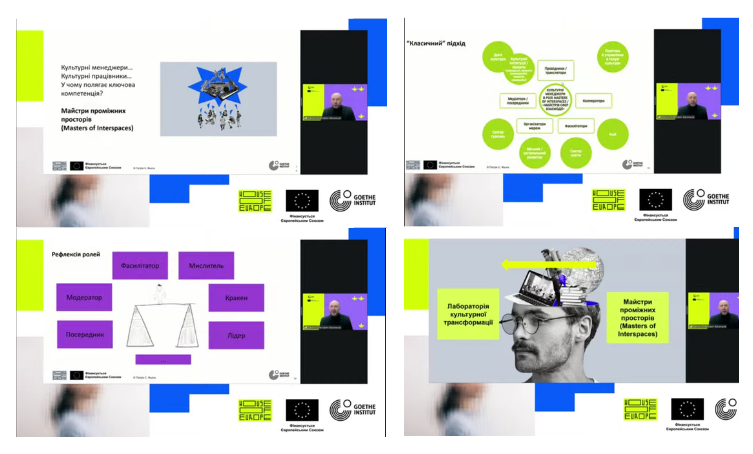
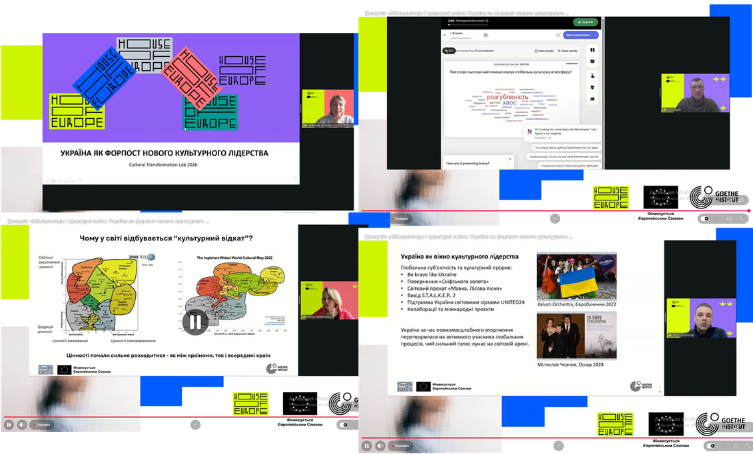
11 лютого 2026 року відбулася онлайн-дискусія «Міжпростори і культурні зміни: Україна як форпост нового культурного лідерства», організована House of Europe у партнерстві з Goethe-Institut Ukraine за фінансової підтримки Європейського Союзу. Захід проходив у межах ініціативи Cultural Transformation Lab, спрямованої на підтримку культурних менеджерів, представників креативних індустрій та громадського сектору, зокрема тих, хто працює в регіонах України в умовах повномасштабної війни.
Участь у дискусії взяли викладачі кафедри економіки, менеджменту та фінансів – Олена Токаренко та Катерина Леміш, що засвідчує активну позицію науково-педагогічних працівників у професійному міжнародному діалозі та їхню зацікавленість у міждисциплінарних підходах до аналізу сучасних суспільних трансформацій.
Метою заходу стало осмислення ролі України як суб’єкта формування нових моделей культурного лідерства в умовах глобальних кризових процесів. У центрі обговорення перебував концепт «міжпростору» як теоретична та практична рамка для розуміння сучасних культурних змін – стану невизначеності, що водночас відкриває можливості для інституційних інновацій, стратегічного переосмислення та партнерської взаємодії.
Під час дискусії було порушено низку ключових питань, зокрема: трансформацію культурного сектору України в умовах війни та перспективи післякризового відновлення; формування нових моделей управління культурними інституціями; подолання ризиків «культурного відкату» та перехід від режиму виживання до моделі сталого розвитку; роль міжнародної співпраці у зміцненні інституційної спроможності та культурної дипломатії.
Обговорення за участі українських та міжнародних експертів у сфері культурної політики, стратегічного планування та креативних індустрій засвідчило, що український досвід інституційної гнучкості, горизонтальної співпраці та стійкості в умовах війни формує підґрунтя для нового типу культурного лідерства.
Залучення викладачів кафедри економіки, менеджменту та фінансів до такого формату професійного діалогу сприяє інтеграції сучасних управлінських підходів у освітній процес, розширенню міжнародних академічних контактів та посиленню науково-методичного потенціалу кафедри в контексті європейської інтеграції.
В умовах триваючої війни культурний сектор України продовжує відігравати стратегічну роль у збереженні національної ідентичності, розвитку громад і формуванні нових моделей суспільної взаємодії.
Важливим виміром обговорення, на якому хотіли б акцентувати учасниці від нашого Університету, стало питання культури менеджменту та етичного лідерства як запобіжника «культурному відкату». Професійна підготовка управлінців у всіх сферах суспільного життя розглядається як основа соціального прогресу та формування унікальної української управлінської культури, що корелює з підходами Індексу соціального прогресу. Окреслені учасниками дискусії цінності – стійкість, гідність, ідентичність, оптимізм та унікальність – постають як фундамент етичного лідерства і чинник піднесення української культури в широкому суспільному вимірі.
За матеріалами кафедри економіки, менеджменту та фінансів
Ukraine as a Frontier of New Cultural Leadership: Outcomes of the International Discussion
On February 11, 2026, the online discussion “Interspaces and Cultural Change: Ukraine as a Frontier of New Cultural Leadership” took place. The event was organized by House of Europe in partnership with Goethe-Institut Ukraine with the financial support of the European Union. It was held within the framework of the Cultural Transformation Lab initiative, aimed at supporting cultural managers, representatives of the creative industries, and civil society actors, particularly those working in the regions of Ukraine under the conditions of the full-scale war.
The discussion was attended by lecturers of the Department of Economics, Management and Finance – Olena Tokarenko and Kateryna Lemish – which demonstrates the active engagement of the academic staff in international professional dialogue and their commitment to interdisciplinary approaches in analyzing contemporary societal transformations.
The purpose of the event was to reflect on Ukraine’s role as a subject shaping new models of cultural leadership amid global crises. Central to the discussion was the concept of the “interspace” as both a theoretical and practical framework for understanding current cultural transformations – a state of uncertainty that simultaneously opens opportunities for institutional innovation, strategic rethinking, and partnership-based interaction.
The discussion addressed a number of key issues, including: the transformation of Ukraine’s cultural sector during wartime and prospects for post-crisis recovery; the development of new governance models for cultural institutions; overcoming the risks of “cultural rollback” and transitioning from a survival mode to a sustainable development model; and the role of international cooperation in strengthening institutional capacity and cultural diplomacy.
The exchange of views among Ukrainian and international experts in cultural policy, strategic planning, and creative industries demonstrated that Ukraine’s experience of institutional flexibility, horizontal cooperation, and resilience in wartime forms the foundation for a new type of cultural leadership.
The involvement of the Department of Economics, Management and Finance in this format of professional dialogue contributes to the integration of modern management approaches into the educational process, the expansion of international academic cooperation, and the strengthening of the Department’s scientific and methodological capacity in the context of European integration.
Amid the ongoing war, Ukraine’s cultural sector continues to play a strategic role in preserving national identity, fostering community development, and shaping new models of social interaction.
An important dimension of the discussion, emphasized by the representatives of our University, was the issue of management culture and ethical leadership as safeguards against “cultural rollback.” Professional training of managers across all spheres of public life is viewed as the foundation of social progress and the formation of a distinctive Ukrainian management culture aligned with the principles of the Social Progress Index. The values outlined during the discussion – resilience, dignity, identity, optimism, and uniqueness – emerge as the cornerstone of ethical leadership and a driving force behind the advancement of Ukrainian culture in a broader societal context.
Based on materials provided by the Department of Economics, Management and Finance.
