
У Київській школі економіки (KSE) відбулася подія, що знову актуалізувала дискусію про так звані «хижацькі журнали» у науковому середовищі.
У центрі обговорення – науковці та експерти з академічної комунікації, зокрема Ігор Сердюк, Сергій Назаровець та Яна Сичікова, а також міжнародні дослідники, автори нових публікацій і аналітичних звітів.
Дискусія про такі видання отримала новий імпульс завдяки статті в журналі Accountability in Research, що ставить під сумнів усталені критерії визначення таких журналів.
Під час заходу Ігор Сердюк представив кейс із публікаціями про вигадану країну – приклад, який раніше активно обговорювався у соцмережах. Саме цей виступ і став відправною точкою для ширшої розмови про якість академічних видань та про критерії їх оцінювання.
Проблема полягає у тому, що традиційний поділ на «хижацькі» та «якісні» журнали отримує дедалі більше критики. Як зазначив Сергій Назаровець, сам термін багато дослідників вважають проблематичним або некоректним.
Додаткового резонансу темі надала нова публікація в журналі Accountability in Research. Її автор аналізує, чи можуть так звані «червоні прапорці» зустрічатися і в легітимних журналах. Мова про ознаки, що традиційно вказують на недоброчесні видання:
- відсутність рецензування;
- агресивні запрошення;
- гарантування швидкої публікації;
- приховані публікаційні платежі тощо.
Як показує дослідження, окремі такі риси дійсно трапляються навіть у виданнях, що індексуються престижними базами.
Це ставить під сумнів ефективність популярних інструментів ідентифікації сумнівних журналів, зокрема списків на кшталт переліку, запропонованого Джеффрі Білом або сучасної бази Cabells. Вони фіксують потенційні ризики, але не дають остаточних оцінок якості.
Водночас інший підхід пропонує звіт STM Association, який фокусується не на ярликах, а на механізмах зловживань (фабрики статей, маніпуляції рецензуванням). У відповідь на ці виклики з’являються міжнародні ініціативи, такі як COPE або Think. Check. Submit, що допомагають дослідникам орієнтуватися у складному середовищі публікацій.
Яна Сичікова звернула увагу на дослідження Jaime Teixeira da Silva та Сергія Назаровця, яке демонструє трансформацію принципу «publish or perish» у більш складну систему академічного тиску.
У підсумку експерти дійшли висновку: проблема недоброчесних або сумнівних видань значно ширша. Йдеться про системність, пов’язану з економікою наукових публікацій, вимогами до науковців та інституційними стимулами.
Саме тому, як наголошують учасники дискусії, рішення потребує комплексного підходу: від реформування державної політики у сфері науки до розвитку культури дослідницької доброчесності.
За матеріалами фейсбук-сторінки Яни Сичікової
KSE: “predatory journals” and the academic environment
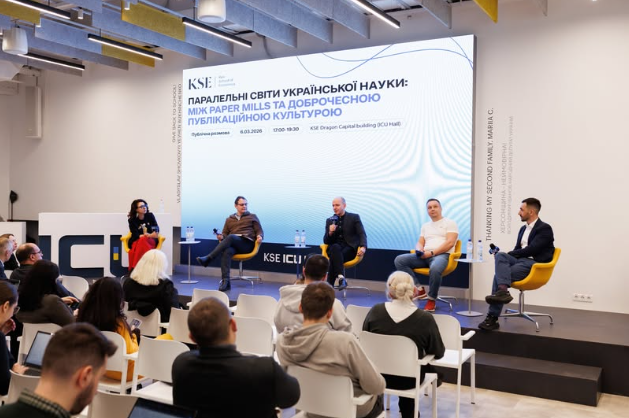
The Kyiv School of Economics (KSE) hosted an event that rekindled the discussion about so-called “predatory journals” in the academic environment.
The discussion focused on scholars and experts in academic communication, including Igor Serdiuk, Serhii Nazarovets, and Yana Sychikova, as well as international researchers, authors of new publications and analytical reports.
The discussion about such publications received new impetus thanks to an article in the journal Accountability in Research, which questions the established criteria for defining such journals.
During the event, Igor Serdiuk presented a case study with publications about a fictional country, an example that had previously been actively discussed on social networks. It was this speech that became the starting point for a broader conversation about the quality of academic publications and the criteria for evaluating them.
The problem is that the traditional division into “predatory” and “quality” journals is receiving increasing criticism. As Serhii Nazarovets noted, many researchers consider the term itself problematic or incorrect.
A new publication in the journal Accountability in Research has given the topic additional resonance. Its author analyzes whether the so-called “red flags” can also be found in legitimate journals. We are talking about signs that traditionally indicate unscrupulous publications:
- lack of peer review;
- aggressive invitations;
- guarantee of quick publication;
- hidden publication fees, etc.
As the study shows, some of these features do indeed occur even in publications indexed by prestigious databases.
This calls into question the effectiveness of popular tools for identifying dubious journals, in particular lists such as the one proposed by Jeffrey Beale or the modern Cabells database. They capture potential risks, but do not provide final quality assessments.
At the same time, a different approach is offered by the STM Association report, which focuses not on labels, but on mechanisms of abuse (article factories, manipulation of peer review). In response to these challenges, international initiatives such as COPE or Think. Check. Submit are emerging, helping researchers navigate the complex publishing environment.
Yana Sychikova drew attention to the study by Jaime Teixeira da Silva and Serhii Nazarovets, which demonstrates the transformation of the “publish or perish” principle into a more complex system of academic pressure.
As a result, the experts concluded: the problem of dishonest or questionable publications is much broader. It is a systemic issue related to the economics of scientific publications, requirements for scientists, and institutional incentives.
That is why, as the participants in the discussion emphasize, the solution requires a comprehensive approach: from reforming state policy in the field of science to developing a culture of research integrity.
Based on materials from Yana Sychikova’s Facebook page
