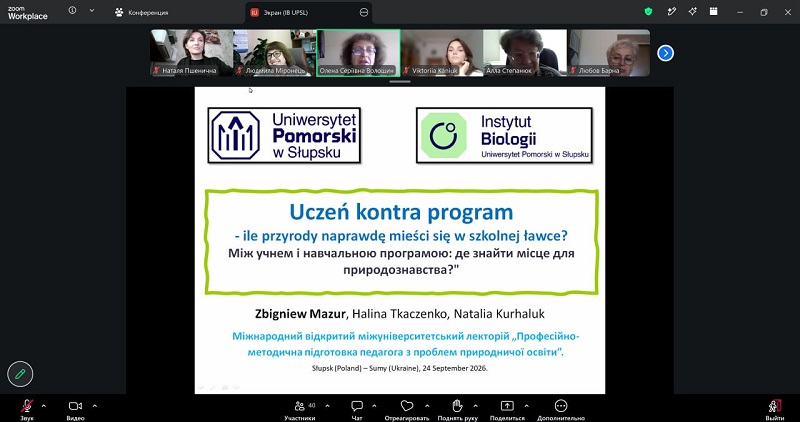
24 вересня 2026 року викладачі кафедри біології, здоров’я людини та фізичної реабілітації та здобувачі магістерського рівня, які навчаються за ОПП «Середня освіта. Біологія та здоров’я людини» та «Біологія та здоров’я людини» долучилися до гостьової лекції «Між учнем і навчальною програмою: де знайти місце для природознавства?», що відбулася в межах Міжнародного відкритого міжуніверситетського лекторію «Професійно-методична підготовка педагога з проблем природничої освіти».
Лектором став Збігнєв Мазур (Zbigniew Mazur), докторант Інституту біології Поморського університету у Слупську (Польща). Лекція, що супроводжувалася синхронним перекладом українською мовою, дала можливість майбутнім педагогам познайомитися з досвідом організації природничої освіти в польській школі та водночас замислитися над значно ширшим питанням: скільки справжнього дослідження залишається на уроці, якщо учень переважно відтворює готові знання?
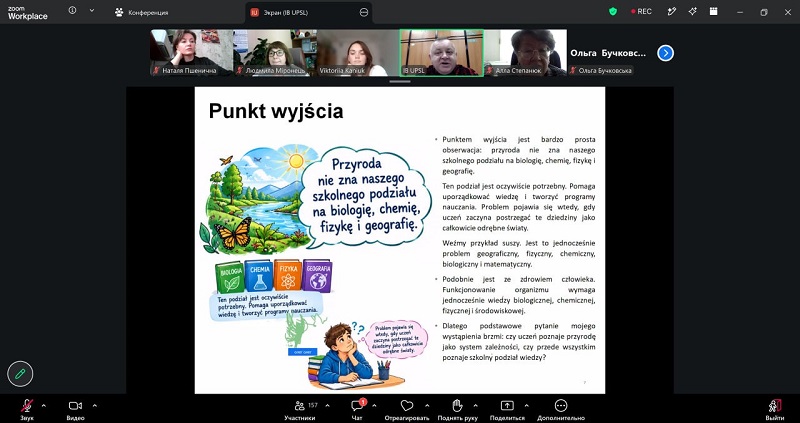
Одним із центральних питань зустрічі стали зміни у природничій освіті Польщі. Із 2026 року новий формат інтегрованого курсу природничої галузі поступово запроваджується у 4–6 класах і передбачає поєднання біологічного, географічного, хімічного та фізичного складників. Проте, як наголосив лектор, сама зміна програми ще не гарантує зміни способу навчання. Вирішальним залишається те, що саме робить учень у відведений на природничі дисципліни час.
Особливу увагу було приділено дослідницькій діяльності школярів. Спостереження, постановка запитання, формулювання гіпотези, планування й проведення дослідження, аналіз отриманих даних та формулювання висновку перетворюють учня з одержувача готової інформації на молодого дослідника. У цьому контексті прозвучала важлива думка: експеримент на уроці має бути не видовищним доповненням до пояснення вчителя, а способом пошуку відповіді на дослідницьке запитання. Навіть результат, який не підтвердив початкову гіпотезу, не є невдачею – він може стати початком нового етапу пізнання.
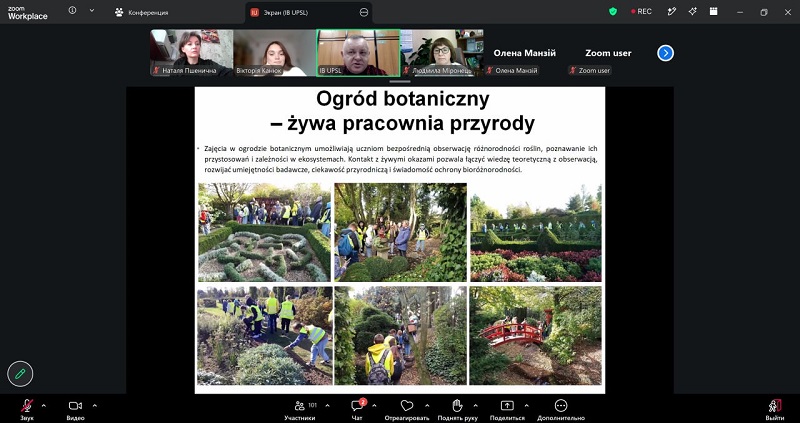
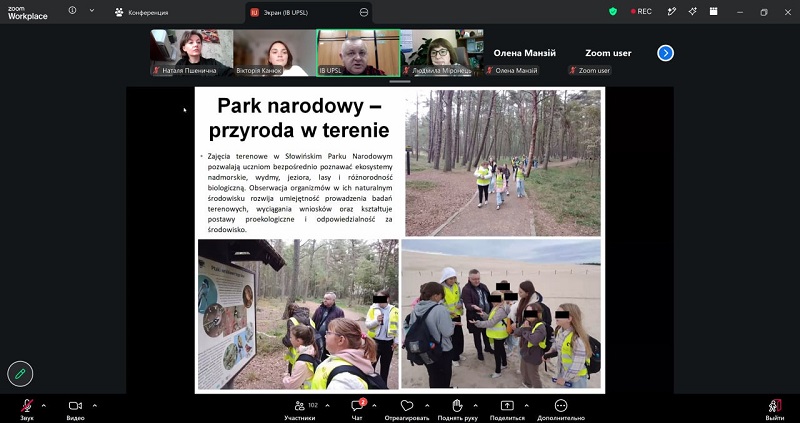
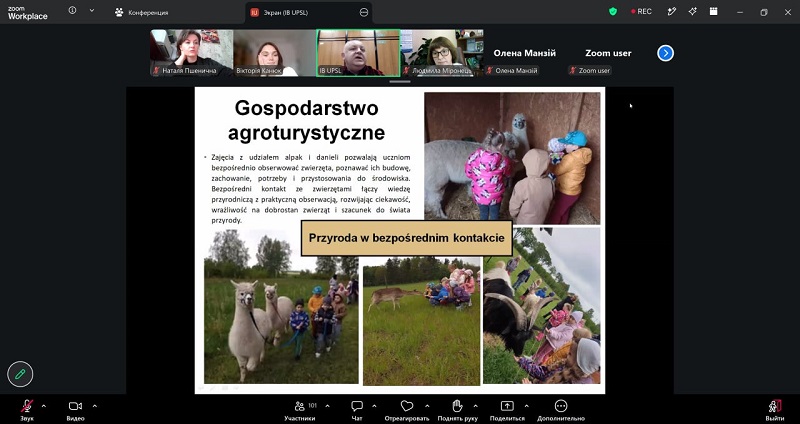
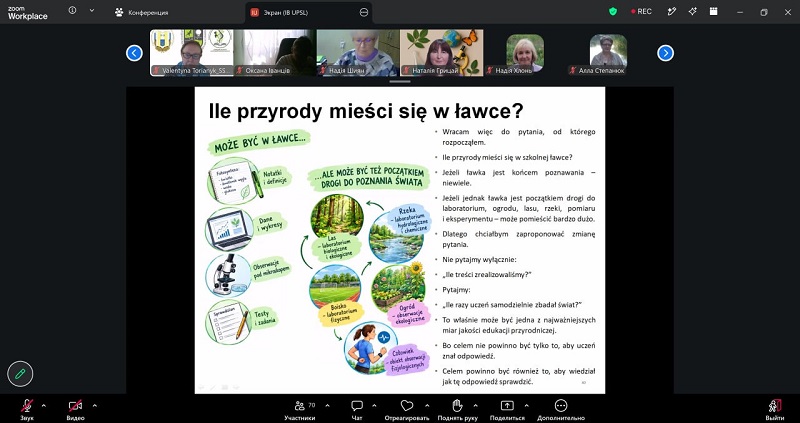
Цікавим був і погляд на освітній простір для вивчення природи. Природнича освіта не обмежується шкільною партою чи лабораторією: місцем спостереження й дослідження можуть стати ботанічний сад, ліс, національний парк, зоопарк, агротуристичне господарство і навіть рослина у приміщенні школи. Не завжди для справжнього дослідження потрібне складне обладнання – інколи достатньо простих засобів вимірювання, добре сформульованого запитання і можливості спостерігати за реальним об’єктом або процесом.
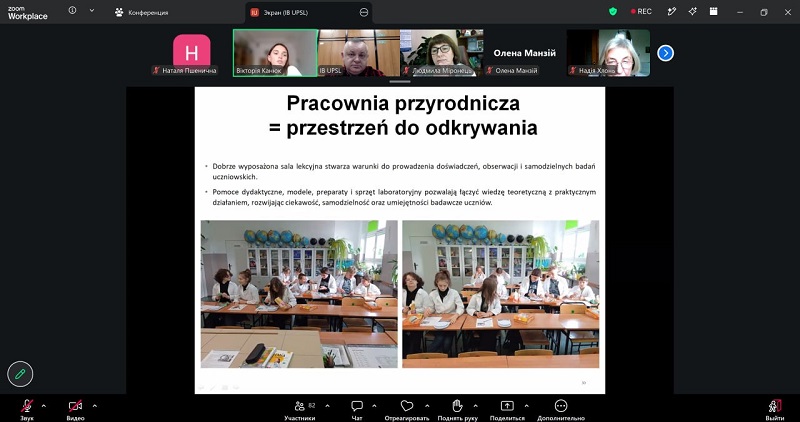
Окремий блок лекції було присвячено матеріально-технічному забезпеченню природничої освіти. Обладнана лабораторія, мікроскопи, вимірювальні прилади, моделі та інші засоби створюють можливості для практичної роботи, однак самі по собі не формують дослідницьких компетентностей. Обладнання починає «працювати» на освіту тоді, коли учень сам ставить запитання, готує дослід, спостерігає, фіксує результати та намагається їх пояснити.
Не менш важливим стало питання міждисциплінарності. Реальні проблеми не вкладаються в межі одного шкільного предмета: зміна клімату не є винятково географією, здоров’я людини – лише біологією, а енергетичні проблеми – тільки фізикою. Дослідження якості повітря, стану екосистем чи інших явищ потребує одночасного залучення знань із біології, хімії, фізики, географії та математики. Саме тому міждисциплінарний підхід дозволяє учневі побачити не окремі фрагменти знань, а цілісну картину світу.
Логічним продовженням розмови стало питання оцінювання. Якщо метою навчання є розвиток уміння досліджувати й міркувати, то оцінювати необхідно не лише кінцеву правильну відповідь. Значення мають сформульоване учнем запитання, план дослідження, якість зібраних даних, спосіб їх інтерпретації, аргументація та обґрунтованість висновків. Важливо не лише те, якої відповіді дійшов учень, а й те, як він до неї прийшов.
Для майбутніх учителів біології та здоров’я людини участь у таких зустрічах є можливістю побачити, як сучасні принципи природничої освіти реалізуються у практиці іншої європейської країни, зіставити різні освітні підходи та поповнити власну методичну скарбничку конкретними ідеями для майбутньої професійної діяльності.
Гарант ОПП «Біологія та здоров’я людини»
доцент кафедри біології, здоров’я людини та фізичної реабілітації
Наталя Пшенична
Teaching Students to Explore: Current Trends in Science Education
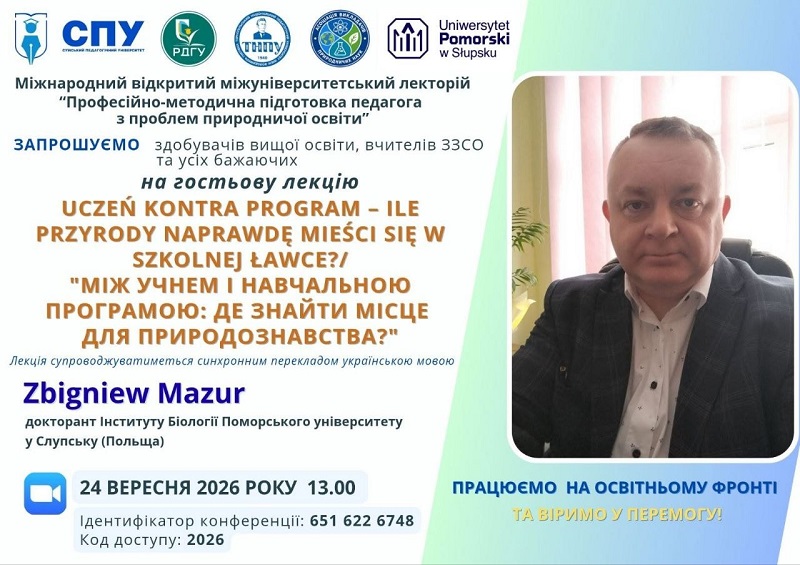
On September 24, 2026, lecturers of the Department of Biology, Human Health and Physical Rehabilitation and Master’s students enrolled in the educational and professional programmes “Secondary Education. Biology and Human Health” and “Biology and Human Health” attended the guest lecture “Between the Student and the Curriculum: Where Is the Place for Science Education?”, held within the framework of the International Open Inter-University Lecture Series “Professional and Methodological Training of Educators in Science Education.”
The lecture was delivered by Zbigniew Mazur, a doctoral student at the Institute of Biology, Pomeranian University in Słupsk (Poland). The lecture, accompanied by simultaneous interpretation into Ukrainian, gave future educators an opportunity to learn about the organisation of science education in Polish schools and, at the same time, to reflect on a much broader question: how much genuine inquiry remains in a lesson when students primarily reproduce ready-made knowledge?
One of the central topics of the meeting was the ongoing transformation of science education in Poland. From 2026, a new format of an integrated science course is being gradually introduced in Grades 4–6, combining biological, geographical, chemical and physical components. However, as the lecturer emphasised, changing the curriculum alone does not guarantee a change in the way students learn. What ultimately matters is what students actually do during the time allocated to science education.
Particular attention was paid to students’ inquiry-based activities. Observation, asking questions, formulating hypotheses, planning and conducting investigations, analysing collected data and drawing conclusions transform students from recipients of ready-made information into young researchers. In this context, an important idea was highlighted: an experiment in the classroom should not merely be an impressive addition to the teacher’s explanation but rather a means of finding an answer to a research question. Even a result that does not confirm the initial hypothesis should not be regarded as a failure – it can become the starting point for a new stage of inquiry.
Another interesting aspect concerned the educational environment for studying nature. Science education is not confined to the school desk or laboratory: a botanical garden, forest, national park, zoo, agritourism farm, or even a plant growing inside a school building can become a place for observation and investigation. Genuine inquiry does not always require sophisticated equipment – sometimes simple measuring tools, a well-formulated question and an opportunity to observe a real object or process are enough.
A separate part of the lecture focused on the facilities and equipment required for science education. A well-equipped laboratory, microscopes, measuring instruments, models and other resources create opportunities for practical work; however, they do not develop inquiry skills on their own. Equipment truly begins to “work” for education when students ask their own questions, prepare experiments, observe, record results and attempt to explain them.
Interdisciplinarity was another important issue discussed during the lecture. Real-world problems do not fit neatly within the boundaries of a single school subject: climate change is not exclusively a matter of geography, human health is not solely biology, and energy-related issues cannot be reduced to physics alone. Investigating air quality, the condition of ecosystems and other phenomena requires the simultaneous application of knowledge from biology, chemistry, physics, geography and mathematics. An interdisciplinary approach therefore enables students to see not isolated fragments of knowledge but a coherent picture of the world.
The discussion naturally continued with the issue of assessment. If the aim of education is to develop students’ ability to investigate and reason, assessment should not focus solely on the final correct answer. The question formulated by the student, the investigation plan, the quality of the data collected, the way the data are interpreted, the reasoning and the validity of the conclusions all matter. What is important is not only the answer a student arrives at, but also how they arrive at it.
For future teachers of biology and human health, participation in such events provides an opportunity to see how contemporary principles of science education are implemented in another European country, to compare different educational approaches, and to enrich their own methodological toolkit with practical ideas for their future professional activities.
Guarantor of the Educational and Professional Programme “Biology and Human Health”
Associate Professor of the Department of Biology,
Human Health and Physical Rehabilitation
Natalia Pshenychna
