
28 жовтня 2026 року відбулася загальноуніверситетська лекція «Неуважність, прокрастинація чи РДУГ? Як працює наша увага в цифрову епоху», яку провела кандидатка психологічних наук, доцентка кафедри прикладної психології та логопедії Марина Федоренко.
Зустріч стала нагодою поглянути на звичні ситуації з повсякденного життя крізь призму психологічної науки. Чому, сідаючи за важливу роботу, ми раптом опиняємося в соціальних мережах? Чому відкладаємо справи, навіть усвідомлюючи їхню важливість? І чи завжди труднощі з концентрацією свідчать про розлад дефіциту уваги з гіперактивністю (РДУГ)?
Учасники розглянули, як працюють різні компоненти уваги, чому часте переключення між завданнями виснажує когнітивні ресурси та як цифрове середовище конкурує за нашу зосередженість. Особливу увагу було приділено психологічним механізмам прокрастинації, яка нерідко виявляється не проявом ліні, а способом уникнення тривоги, невизначеності, страху помилки чи інших неприємних переживань.
Окремий блок лекції присвятили РДУГ – нейророзвитковому розладу, який не можна ототожнювати зі звичайною неуважністю або надмірним користуванням смартфоном. На прикладах із повсякденного життя учасники вчилися розрізняти ситуативні труднощі концентрації, прокрастинацію та можливі прояви стійких порушень регуляції уваги. Важливим акцентом стало розуміння того, що за зовні схожою поведінкою можуть стояти зовсім різні психологічні та нейророзвиткові механізми.
Теоретичну частину доповнили практичні рекомендації щодо організації власної діяльності: від керування цифровими сповіщеннями та структурування складних завдань до використання робочих інтервалів, усвідомленого перемикання уваги й турботи про повноцінний відпочинок. Учасники також мали можливість провести своєрідний аудит власної уваги, замислитися над причинами відволікання та визначити, що саме заважає їм зосереджуватися.
За матеріалами кафедри прикладної психології та логопедії
Марина Федоренко
Inattention, Procrastination or ADHD? How to Maintain Focus in the Digital Age
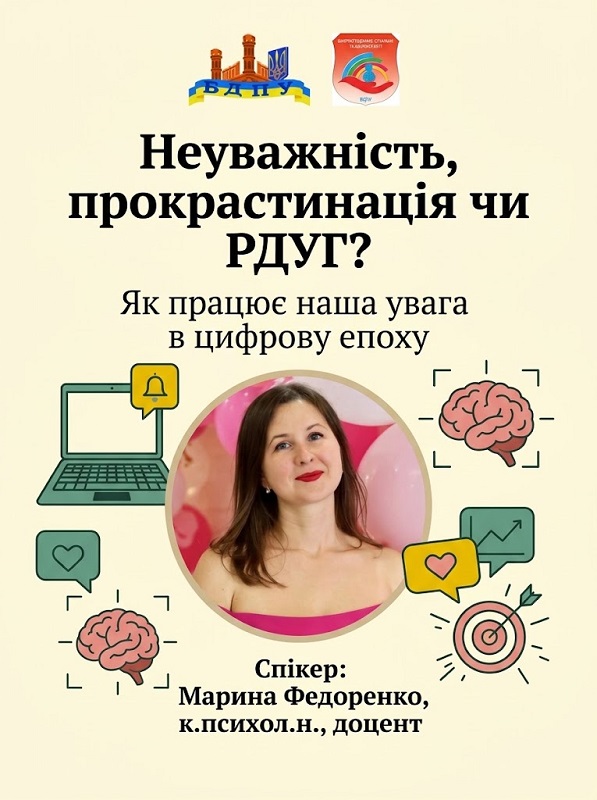
On 28 October 2026, a university-wide lecture entitled “Inattention, Procrastination or ADHD? How Does Our Attention Work in the Digital Age?” was delivered by Marina Fedorenko, PhD, Associate Professor at the Department of Applied Psychology and Speech Therapy.
The lecture provided an opportunity to look at familiar everyday situations through the lens of psychological science. Why is it that, when we sit down to work on an important task, we suddenly find ourselves scrolling through social media? Why do we put things off even when we know how important they are? And do difficulties with concentration always indicate attention-deficit/hyperactivity disorder (ADHD)?
Participants explored how different components of attention work, why frequently switching between tasks depletes cognitive resources, and how the digital environment competes for our attention. Particular attention was paid to the psychological mechanisms underlying procrastination, which is often not a sign of laziness but rather a way of avoiding anxiety, uncertainty, fear of making mistakes, or other unpleasant emotions.
A separate section of the lecture focused on ADHD, a neurodevelopmental disorder that should not be equated with ordinary inattention or excessive smartphone use. Using examples from everyday life, participants learned to distinguish between situational difficulties with concentration, procrastination, and possible manifestations of persistent difficulties with attention regulation. An important point was that outwardly similar behaviours may have very different underlying psychological and neurodevelopmental mechanisms.
The theoretical discussion was complemented by practical recommendations for organising everyday activities, ranging from managing digital notifications and breaking down complex tasks into manageable steps to using focused work intervals, switching attention mindfully, and ensuring adequate rest. Participants also had the opportunity to carry out a personal attention audit, reflect on the reasons behind their distractions, and identify the factors that make it difficult for them to concentrate.
Based on materials from the Department of Applied Psychology and Speech Therapy
